
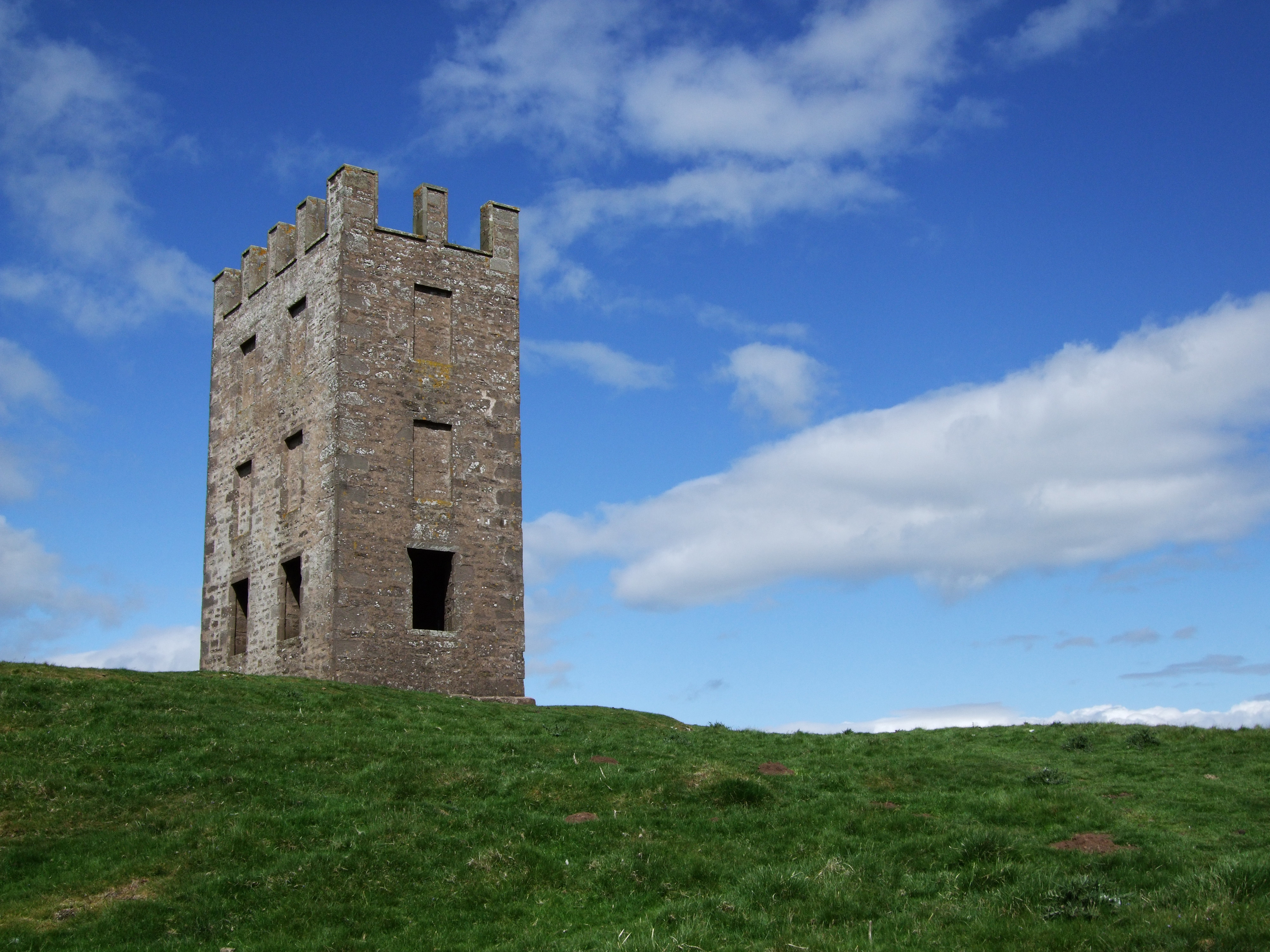
Overlooking the Vale of Strathmore, Kinpurney Hill in Angus is one of my favourite wee hills. The short but strenuous ascent leads to an exposed summit and a ruined tower, said to have once been home to a hermit.
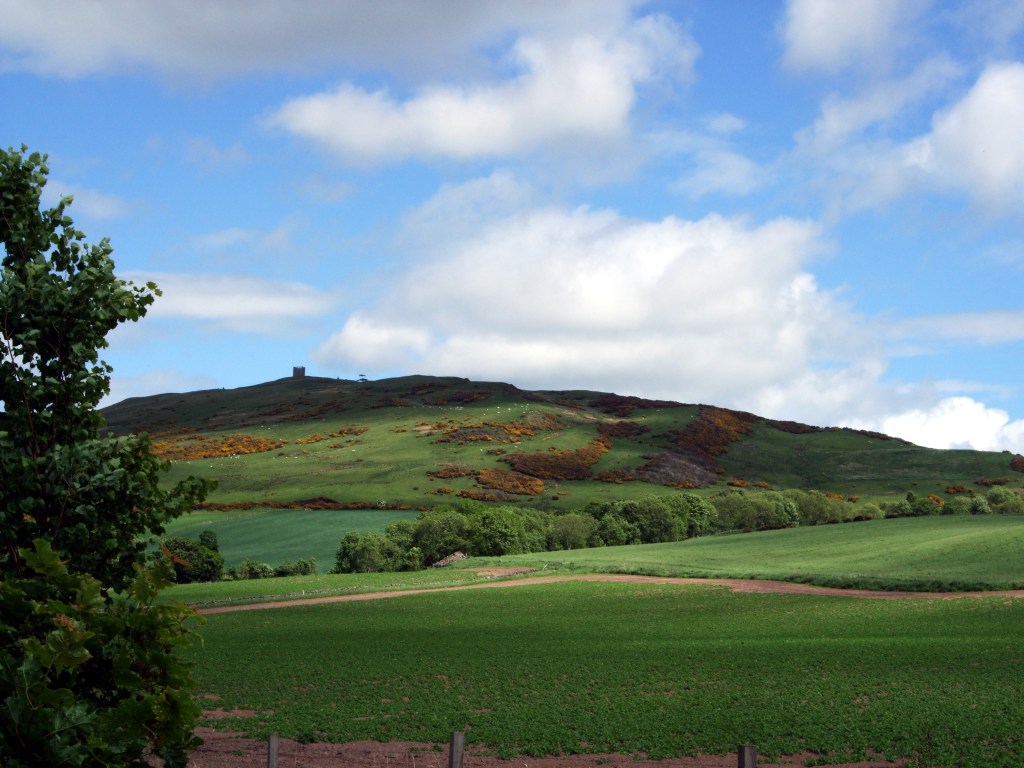
According to local lore, 18th century recluse Davie Gray was tricked into living in the tower by local lairds who were fed up with him poaching fish and game on their land and effectively imprisoned him there for seven years.
The walk to the summit of Kinpurney Hill begins in Newtyle, a village firmly rooted in agriculture that grew and prospered around the terminus of one of Scotland’s earliest railways, the pioneering Dundee to Newtyle Railway. The car park at the start of the walk, located on the eastern edge of the village, occupies part of the old trackbed and from here I set out along North Street, walking west on the country road leading ultimately to Glamis.
Crossing Newtyle Burn and cutting between fertile fields, I followed the ribbon of asphalt as far as Denend, enjoying a fine view of Kinpurney Hill to my right, the tower visible high above. Leaving the road by a steading, I entered The Den, a rich mix of trees, including ash, elm, beech, rowan, sycamore and a smattering of conifers, populating the pretty little gorge.
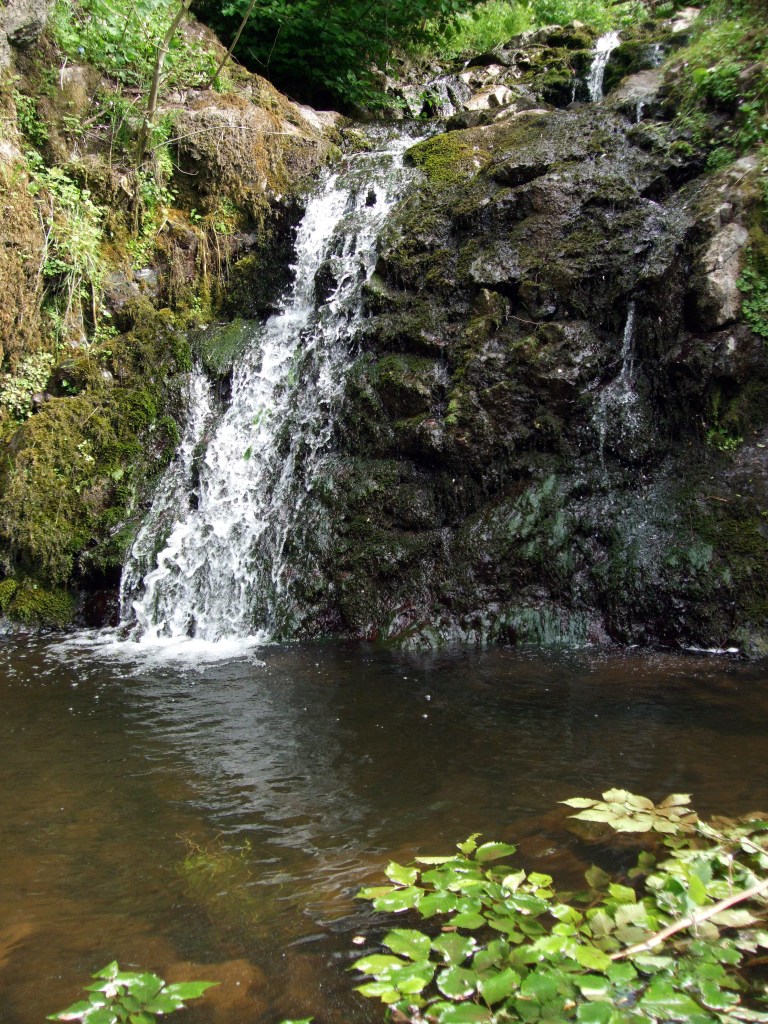
Beneath branches and boughs, the path climbs alongside the tumbling Edderty Burn, passing a heavily silted millpond and then a succession of waterfalls and pools. Steps, bridges and boardwalks lead to a pair of kissing gates between which there is a sturdy bench, a good place to pause for a breather before continuing up the valley.
Exiting the Den at a wooden gate, the path meets a track where a gate in a high fence offers access to Kinpurney Farm Woodland, a relatively new plantation of native trees. A grassy path weaves through the saplings, a couple of waymarker posts keeping walkers on the right route to a second gate high on the hillside.
From here, I continued up the grassy western shoulder of Kinpurney Hill and the castellated top of the tower soon appeared on the skyline, above another bench. With the summit so close at hand, I declined the offer of a seat and pressed on towards a handful of windswept larch trees that form a gateway to the tower and trig point, a welcome end to an energy-sapping ascent.
Ringed by the remains of an Iron Age hill fort, the tower was erected in 1774 by landowner James Stuart-Mackenzie, a keen astronomer, to house an observatory. However, tales are told of a hermit confined within its walls.
Davie Gray was a well known local figure of Dundee and Angus folklore. Legend has it that he roamed the estates to the north of Dundee, Kinpurnie among them, poaching fish and game and what he didn’t eat, he sold to fund his largely itinerant lifestyle. The local lairds took a dim view of this, particularly as he was too quick on his feet for their gamekeepers to catch.
Over dinner one night they colluded to capture him, the Laird of Kinpurnie, who was in the process of completing his tower, suggesting they could incarcerate him within the folly as a hermit. The other landowners agreed and chipped in enough money to complete the tower and offer a wage of £100, which they hoped would be more than enough to tempt Gray to apply.
At the time hermits were very much in vogue, a fashionable distraction for visitors to country estates, and many, both Scotland and England, kept one on their grounds, usually living in solitude in caves, simple huts or grottoes.
Word spread that Kinpurnie was looking to employ a hermit and Gray duly applied. Under the terms of the contract he was expected to spend seven years confined to the tower. Food and drink would be provided and he was given a sheepskin to wear and a rough bed on the floor. He was not allowed to talk to anyone, or wash, or cut his hair or nails.
The lairds did not expect him to stay the course but hoped the experience might break the young man’s spirit and see him off for good. And while he was in the tower he was not poaching on their land. To their surprise, however, he did see out the full seven years but, at the end, emerged frail, unable to speak and possibly quite mad. Within a year of his ‘release’ he contracted a fever and died.
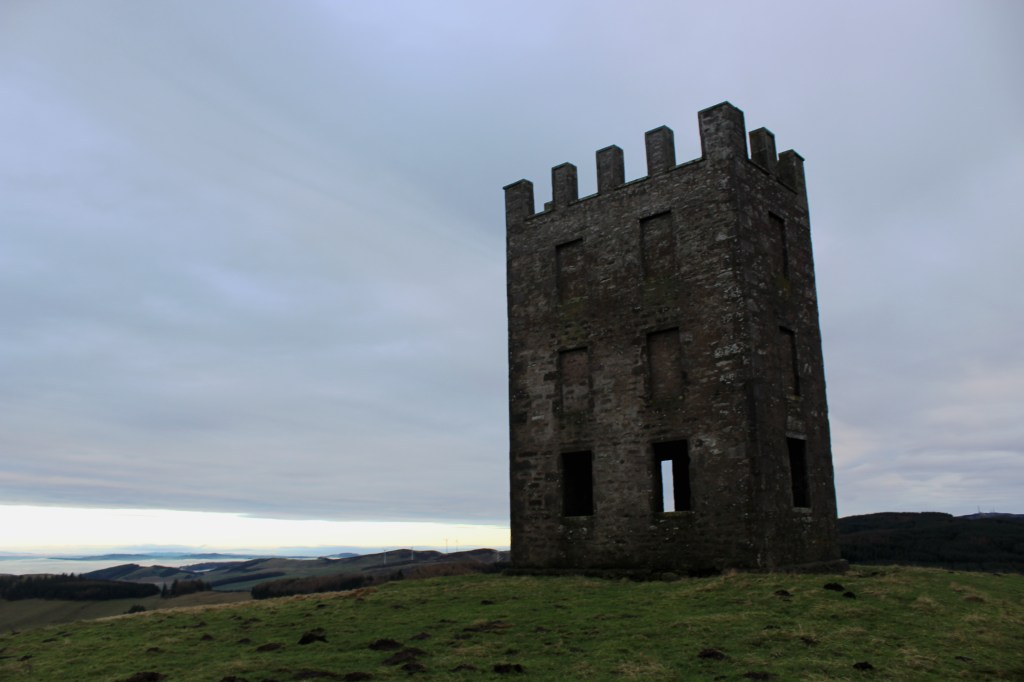
While an enthralling tale, there is no real evidence to support the hermit story and it sits rather at odds with the historically more accurate account of Mackenzie constructing the tower as an observatory. In 1770 he erected another tower, the Mackenzie Meridian Monument, on Keillor Hill, a few miles to the south-west.
Abandoned and roofless by the mid-19th century, Kinpurney Tower fell into serious disrepair and in the early 1970s faced demolition. However, as it was such a familiar landmark, its stone shell was preserved. With no roof and the windows open on all sides, the tower affords little shelter to the visiting walker but there is a cracking vista from beneath its solid stone walls.
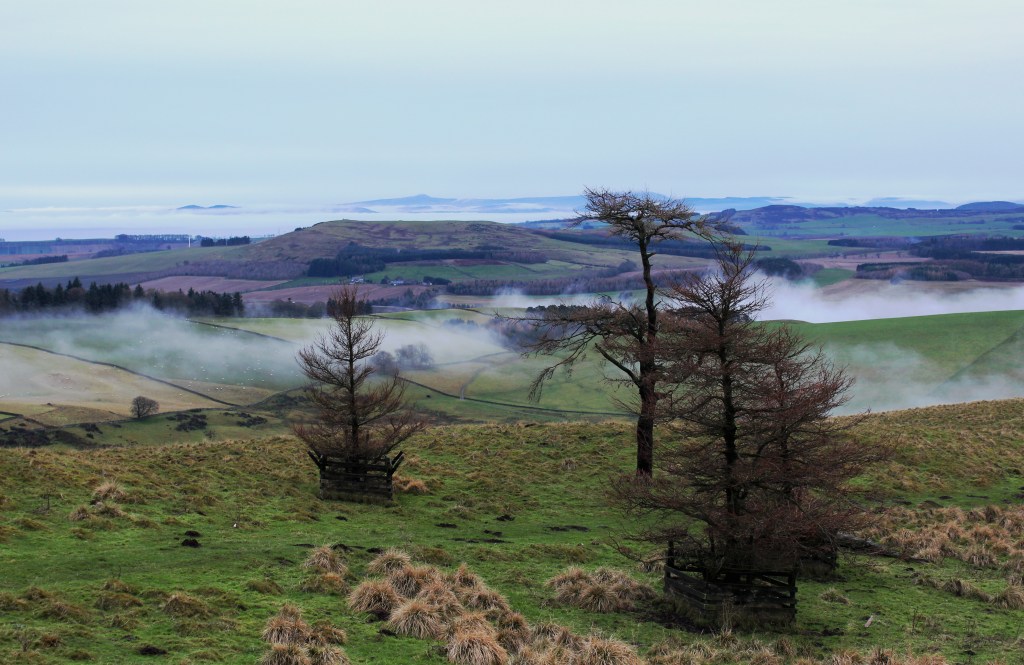
A viewpoint indicator nearby guides the eye north across Strathmore to the hills of the Angus glens and the Grampian mountains beyond and south over the River Tay to the distant Lomond Hills, in Fife.
If you have enjoyed this post, and others on the site, you might like to buy me a coffee which helps support the site…


