
Coal miners were superstitious, shaped by the dangerous conditions they faced daily. One of the most common superstitions related to women underground. Having a woman enter or even go near a mine was seen as serious bad luck. Historically, women tended to gather at the pithead only after underground accidents or disasters. And, in the case of Scotland’s first National Coal Board (NCB) Super Pit, Rothes Colliery in Fife, this belief proved well founded, although in truth there were other physical and economic factors at work that resulted in its swift demise.
Rothes Colliery was a flagship deep-mining project intended to modernize and revive the Scottish coal industry. A state-of-the-art pit, it was one of 15 major new projects contained within the NCB’s ‘Scotland’s Coal Plan’, unveiled in 1955, which outlined a massive new phase of investment and modernisation. Ultimately, the Fife showpiece pit was to employ 2000 people. Instead, it swallowed £20 million of investment, produced a fraction of the coal envisaged, and operated for just five years.
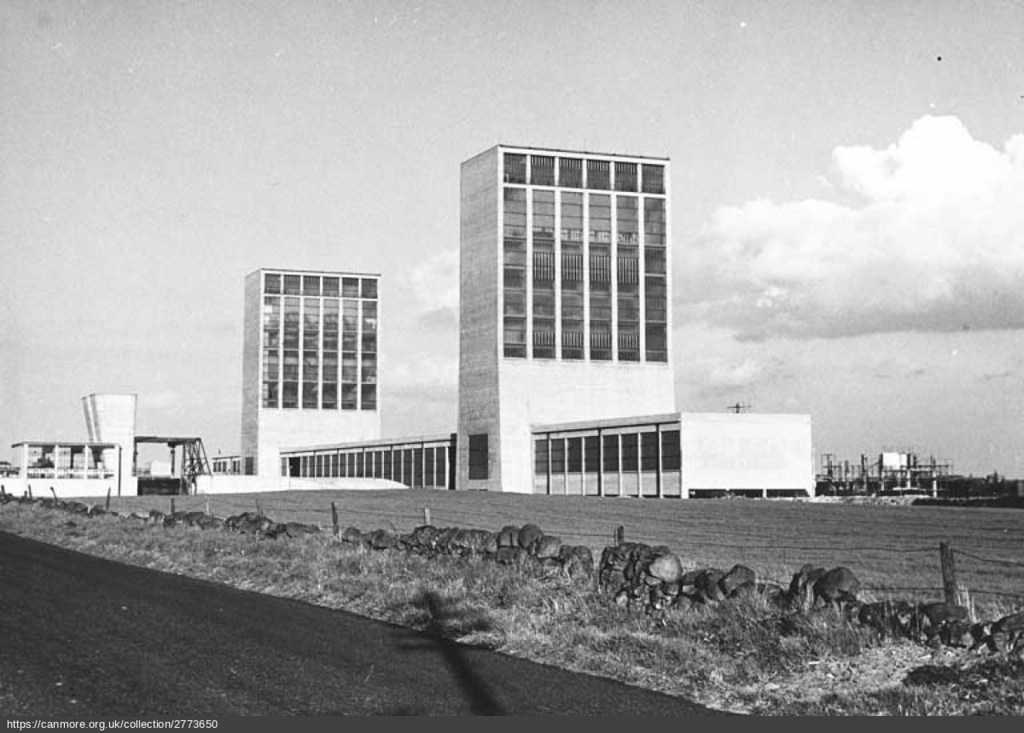
In that time, the project spawned the new town of Glenrothes, designed to house miners who would work the pit, brutalist pithead towers that dominated the landscape for decades to come, and a 78-acre railway marshalling yard. However, what was originally seen as one of the NCB’s most ambitious developments is now widely regarded as one of the costliest industrial mistakes in Scottish history.
It all began in December 1946 when the privately-owned Leven-based Fife Coal Company, once Scotland’s largest coal company, began mining operations to the west of the village of Thornton, a project that was planned in the 1930s but delayed due to the outbreak of the Second World War. A system known as ‘horizon mining’ was to be employed, and it was estimated that coal production would rise from 1000 tons per day initially to 5000 tons per day by 1965. Some suspected, however, that the timing of this new sinking was merely a means for the company to benefit financially from the impending nationalisation of the coal industry.
The Fife Coal Company’s involvement in Rothes was short-lived. On January 1, 1947, Britain’s coal industry was brought under public control, and the newly formed National Coal Board Scottish Division took over the venture. Rothes Colliery was to be its first Super Pit in Scotland, with an anticipated lifespan of 100 years. The NCB planned to sink two shafts to a depth of 2928 feet each and build a modern pithead structure capable of dealing with a daily output of 5000 tons of coal.
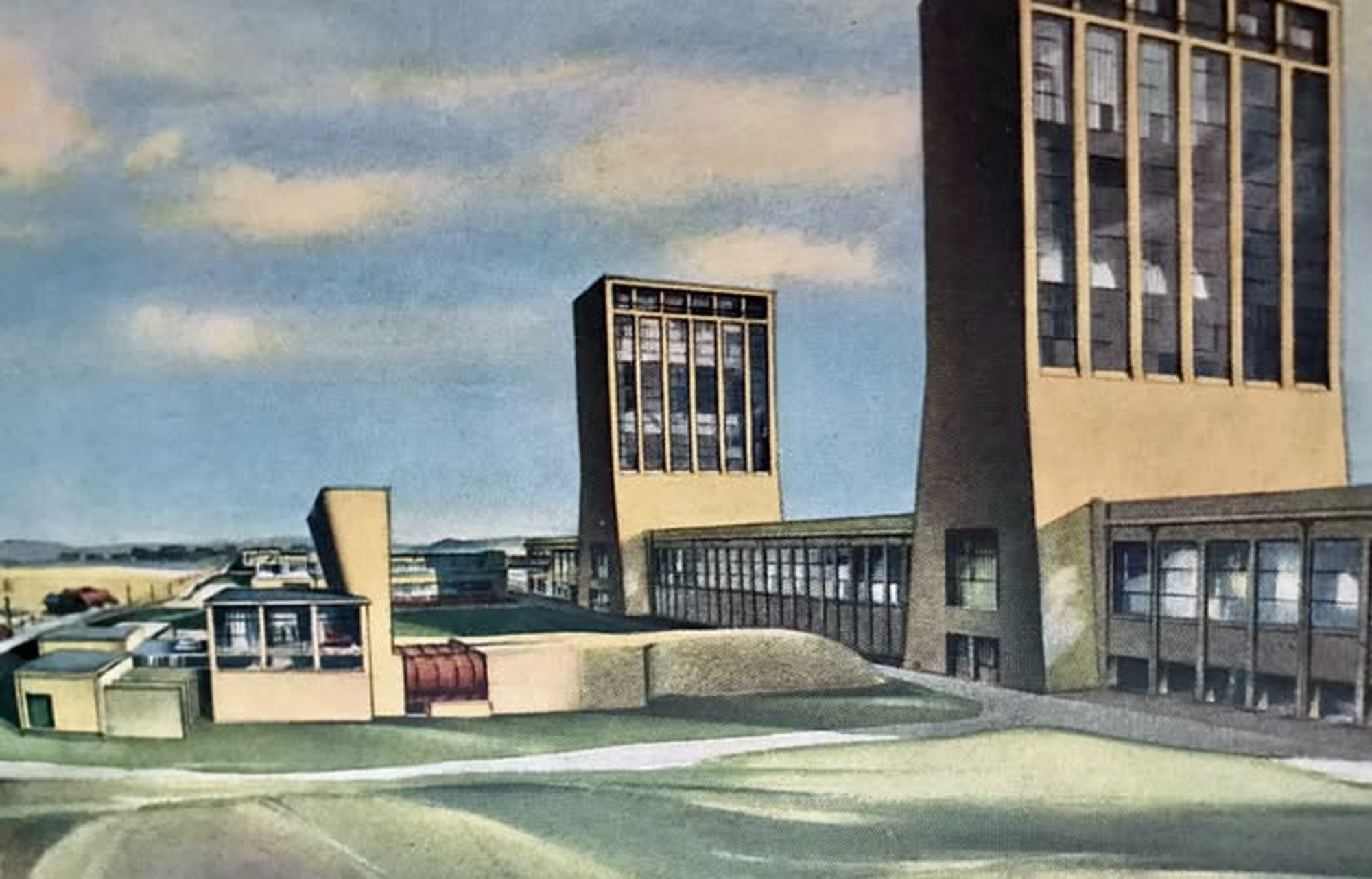
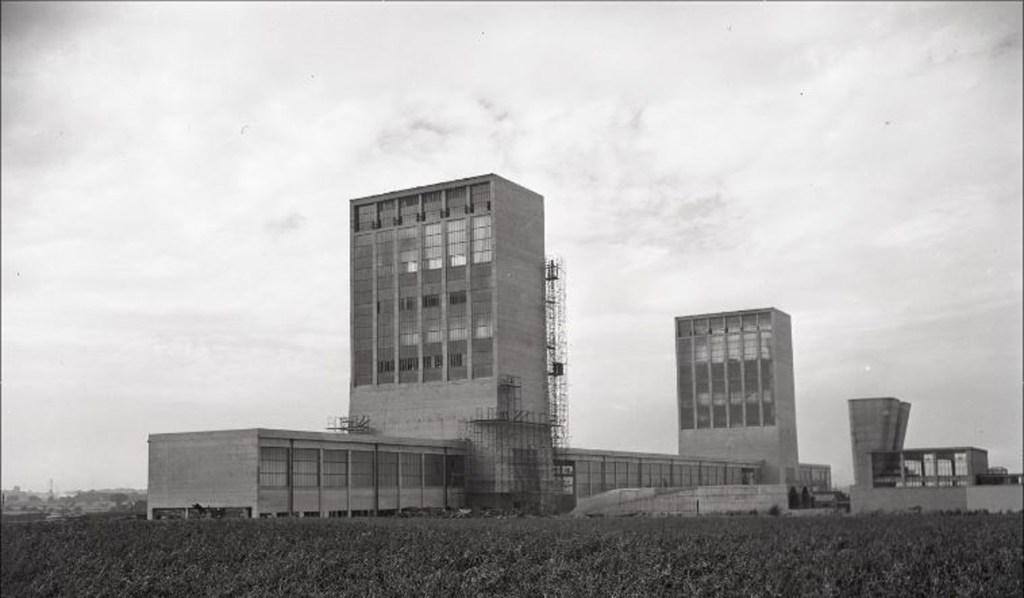
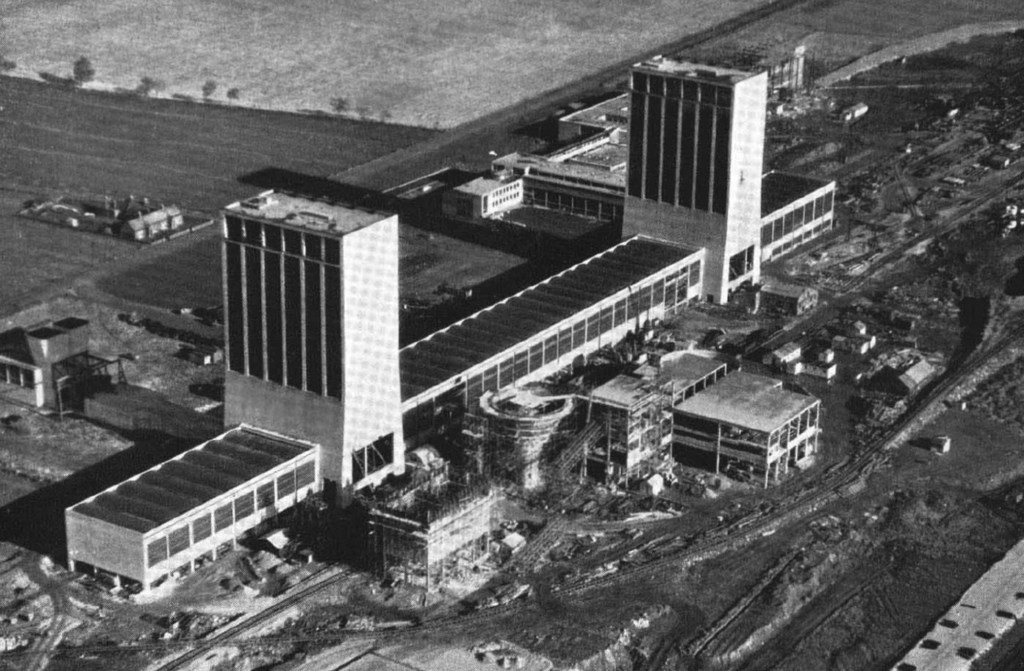
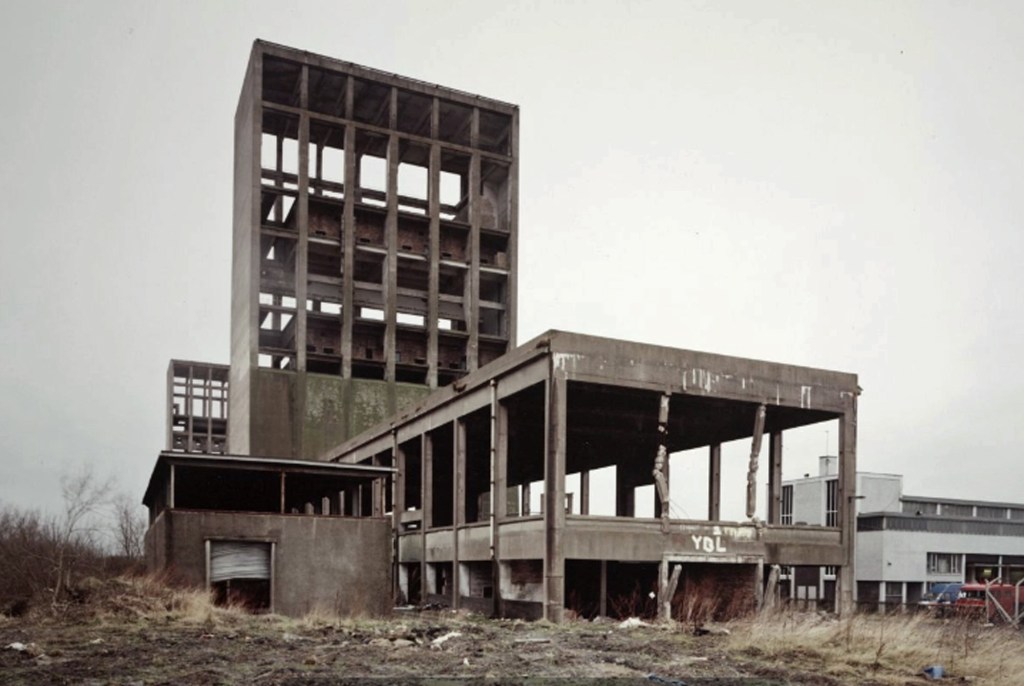
Work on sinking the concrete-lined shafts began in earnest in 1947 and, above each shaft, a 190-foot-high reinforced concrete and glass tower, designed by NCB architect Egon Riss, was constructed to house the modern Koepe electric winding system with its 27-foot-diameter wheels. His striking twin tower design aligned perfectly with the NCB’s desire to project a dynamic, modern image, reflecting the confidence of the era.
The towers were linked by a 930-foot-long car hall designed to handle the mine cars with maximum efficiency. To the north of the car hall and towers, office accommodation was built alongside a boilerhouse, pithead baths, stores, a canteen and a fanhouse. Railway tracks were laid to connect the colliery with the nearby mainline and Thornton Marshalling Yard, which opened in 1956 and had a dedicated branch to Rothes Colliery.
Newspaper reports of 1950 indicated that the two new shafts had reached a depth of 600 feet. Both were due for completion by 1954, although the reports noted ‘water trouble’ in the sinking operations. However, the NCB remained confident that Rothes Colliery would be producing coal in 1956 or 1957.
The NCB envisaged that, to meet its target of 5000 tons of coal per day, 2,276 men would be employed underground with a further 204 workers on the surface. Workers would come from both Fife and from declining coal mining areas further afield, particularly Lanarkshire. The first batch of miners to transfer to Rothes came from Shotts and Fauldhouse in 1959. To house this influx of men and their families, work was underway on the construction of Scotland’s second post-war new town, Glenrothes, designated in 1948 and built on 5,320 acres of land to the north of the colliery. The new mine was viewed as vital to the regeneration of Central Fife, although the authorities were keen to stress that Glenrothes would be more than simply a pit town.
Digging the shafts continued into the 1950s, but contractors faced a daily battle with water as they pushed deeper underground. The Scotsman newspaper of September 8, 1952 reported that the project had slipped several months behind schedule due to the presence of ‘much larger volumes of water than were at first expected’. The NCB said it hoped to make up time but, running two years behind schedule, it decided to suspend work on the shafts in 1953. The priority at that point was to extract coal to meet the anticipated demands of 1957. Number 1 shaft was down to 1859 feet, while Number 2 shaft bottomed out at 1654 feet. It was estimated that it would take another two years to achieve completion. In June 1957, coal extraction finally began at a depth of 1600 feet, but more geological problems soon arose. Tunnels were unstable due to the amount of water in the pit, the coal seams thinned dramatically, unexpected geological faults were found, and both the quality of the coal and the output were well below what was expected. At the start of 1959, Rothes Colliery was producing just 700 tons of coal a day.
Despite problems underground, the NCB (outwardly at least) remained committed to the pit, and on June 30, 1958, it hosted a visit by Queen Elizabeth II to officially open Rothes Colliery. She made history as the first reigning British Queen to descend a coal mine, an event that flew in the face of coal mining superstition. Clad in white overalls, a helmet and heavy boots, she descended 1600 feet underground in the pit cage before walking roughly three-quarters of a mile to inspect the coal face and talk with miners who apparently christened her ‘Snow White’.
Work progressed underground and the workforce peaked at 1235 in 1960. However, with the colliery returning annual losses of over £1 million, an NCB appraisal the following year recommended the transfer of 400 of the 900 remaining miners to other pits and an end to coal production once the existing horizon had been worked out. The coal board reported continuous difficulties with water in the shafts, said to be three times the volume predicted. This and other geological problems described by the coal board as ‘abnormal difficulties’ led to the abandonment of 14 of 16 coal faces which should have yielded 2500 tons a day. Only one horizon, instead of three, was developed because water conditions in the shaft were insurmountable.
The colliery was now being run down, and the inevitable closure came in May 1962, despite a heartfelt plea from the miners to the Queen. The remaining miners opted not to strike as they battled to save their colliery, calling instead on the government to approve a £5 million rescue plan. The money, which would fund completion of the shafts to their originally intended depth, was not forthcoming and the pit closed, written off by the NCB, which opted against retaining the site on a care and maintenance basis. Just days later salvage squads moved in to remove all equipment and tools that could be redeployed to other collieries, and the site was left to decay.
Rothes was not alone in closing in 1962. The NCB also shut down another Super Pit at Glenochil, near Alloa, and a dozen smaller collieries as it grappled to stem increasing losses amid a fall in demand for coal. The new town of Glenrothes survived the collapse of the mine, adapting quickly by adopting light industry and electronics to succeed where coal failed.
The spectacular failure of Rothes Colliery, which produced three-quarters of a million tons of coal in its short life, was blamed on poor planning, geological difficulties and the unprecedented volumes of water encountered, something experienced local miners and landowners warned engineers about before they sank the shafts.
A bid to re-open the colliery in the early 1990s failed and, in March 1993, planning approval was granted to British Coal (successor to the NCB) to demolish the twin towers, iconic landmarks visible for miles around, ending all hopes of coal mining restarting. The towers were brought down using explosives, with the rubble reportedly being bulldozed into the shafts, which were then capped with concrete. Prior to their demolition, the towers and car house were little more than huge concrete shells, their vast expanses of glass gone. Despite being fenced off, the colliery buildings became a haunt for vandals and young people, prompting safety concerns.
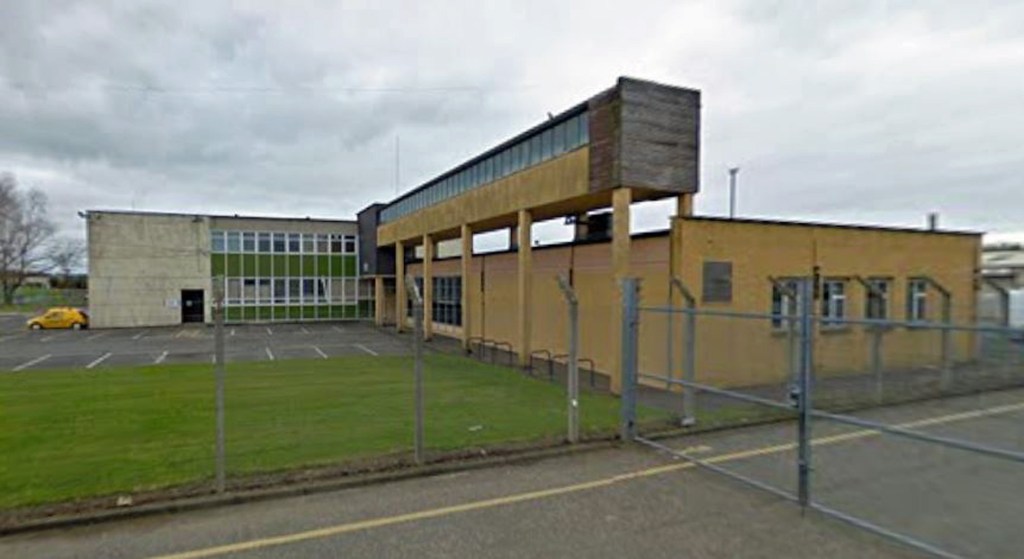
In the intervening years, in 1968, part of the site housing the pit baths and miners’ welfare was redeveloped as the new headquarters of Fife Fire Brigade. In 1973, the colliery’s water-filled shafts were briefly re-opened as a testing centre for submersible equipment such as diving bells designed for the offshore oil and gas industry and armed forces. The fire service also used the shaft infrastructure as a controlled environment for practicing underground rescue operations. In 1980, work began to clear the colliery site for a 65-acre business park, while NCB plans to stockpile coal at the colliery in 1983 and again in 1994 were shelved after strong opposition from local residents.
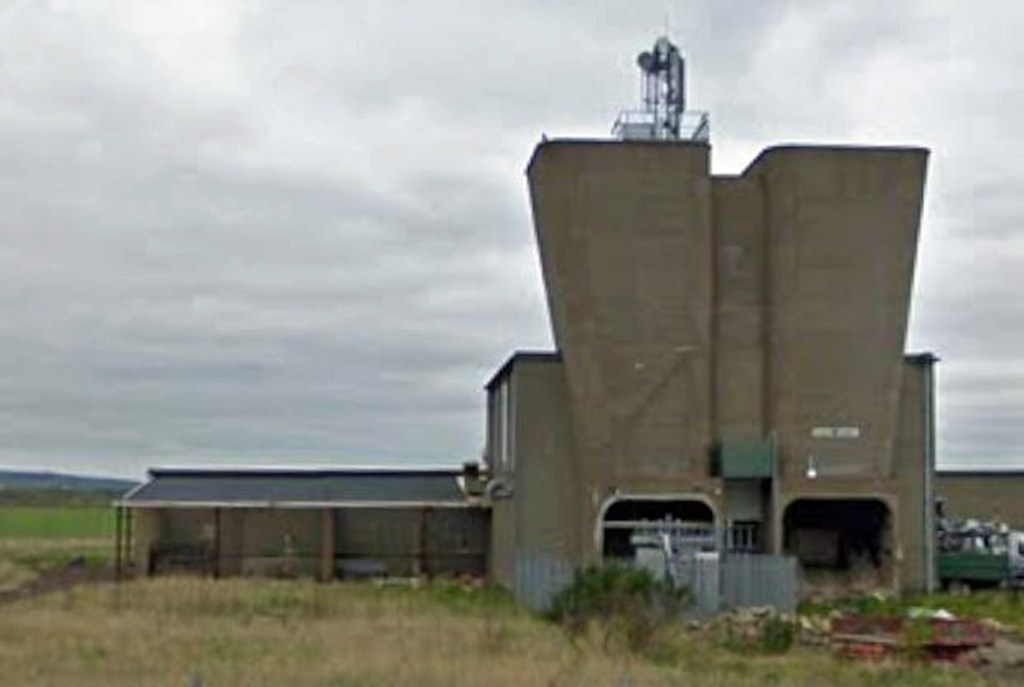
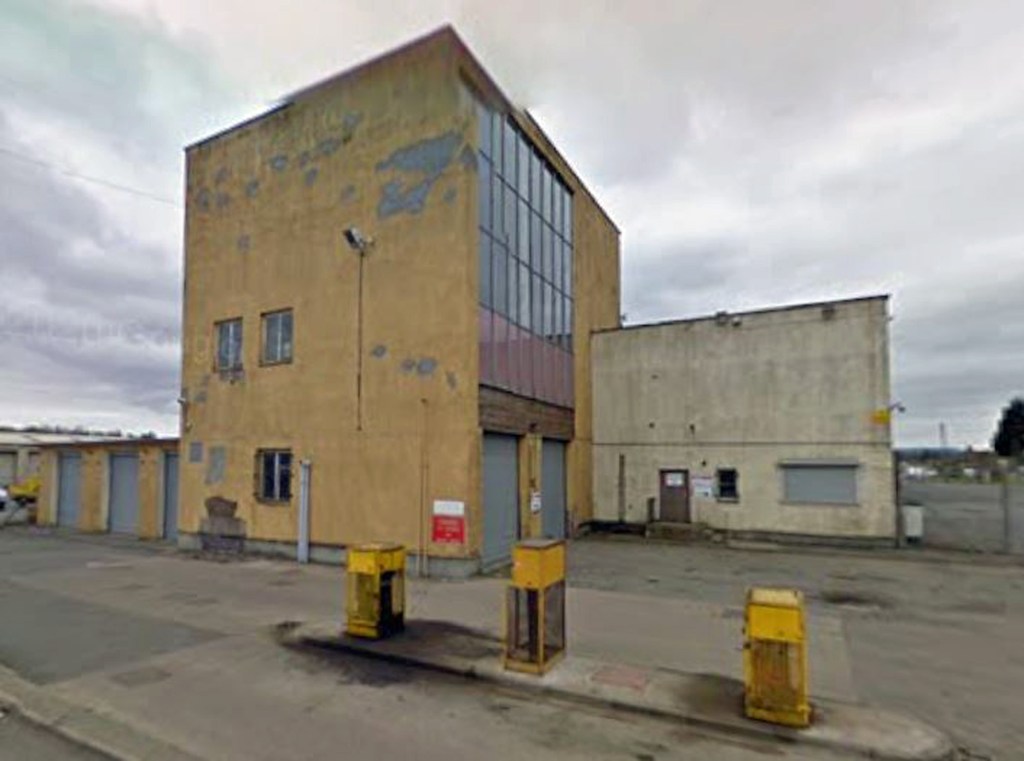
With all traces of the pithead structures gone, only the distinctive fanhouse (occupied by a ventilation company) and the main office block, gas turbine room, and boilerhouse remain. Parts of the site are occupied by a council roads depot and the International Fire & Rescue Association, a charity that supplies redundant or surplus fire appliances, ambulances, medical supplies, and rescue gear to emergency services worldwide.
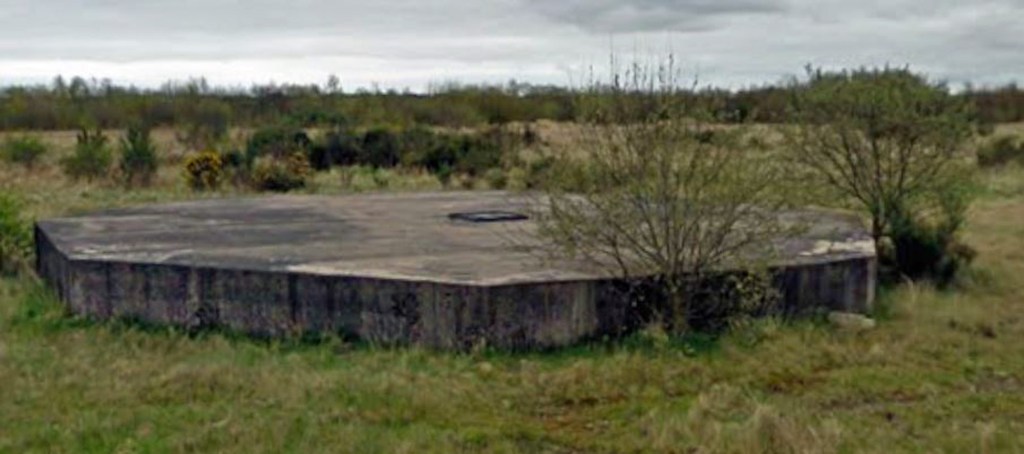
The ground occupied by the winding towers and car hall has reverted to rough heathland. Adjacent to a roadway running along the back of the business park are two final reminders of Rothes Colliery, a pair of large octagonal concrete slabs sitting roughly 500 metres apart. These are the caps sitting atop the abandoned shafts.
For more abandoned places in Fife, check out my book Abandoned Fife, available in paperback and as an ebook from Amazon.
If you have enjoyed this article, you might like to PayPal.me or buy me a coffee, which helps support the site and funds new content.


