
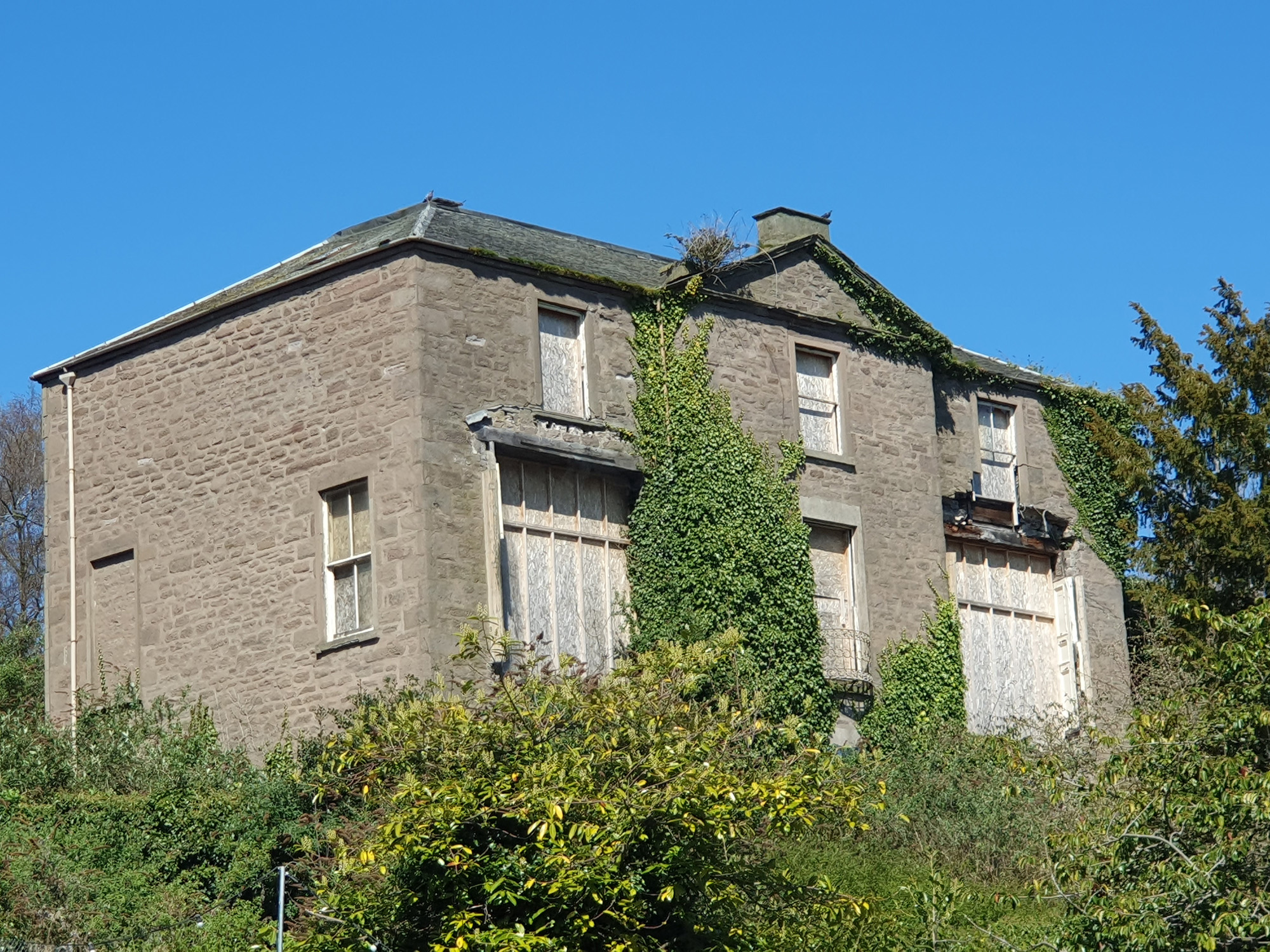
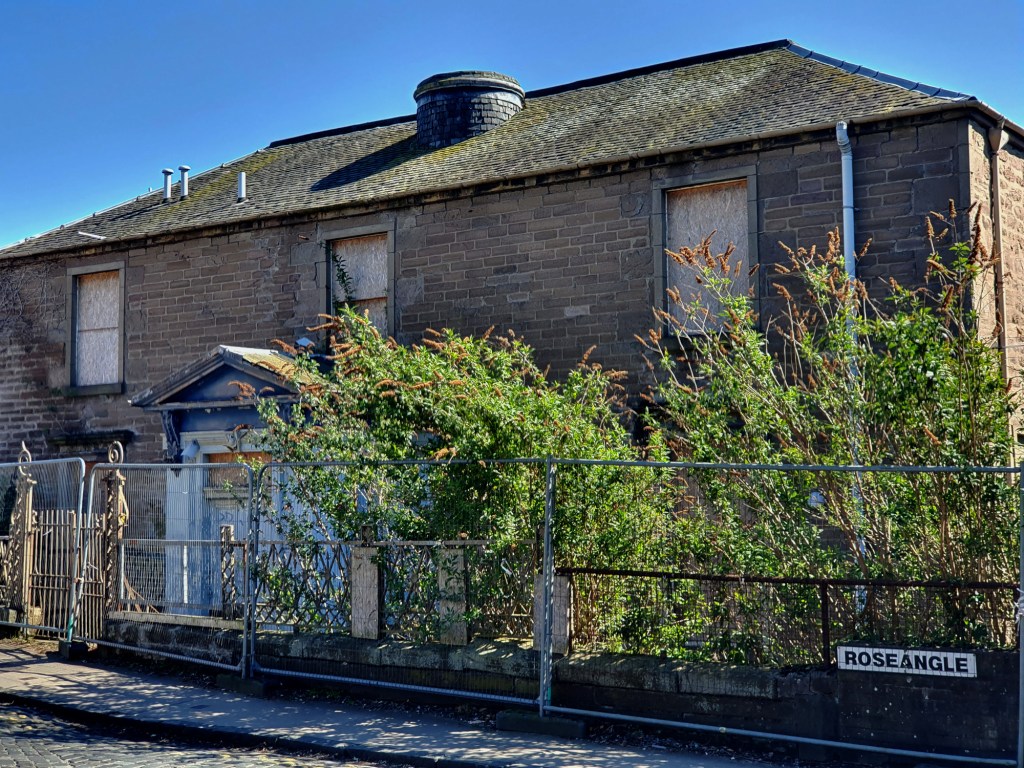
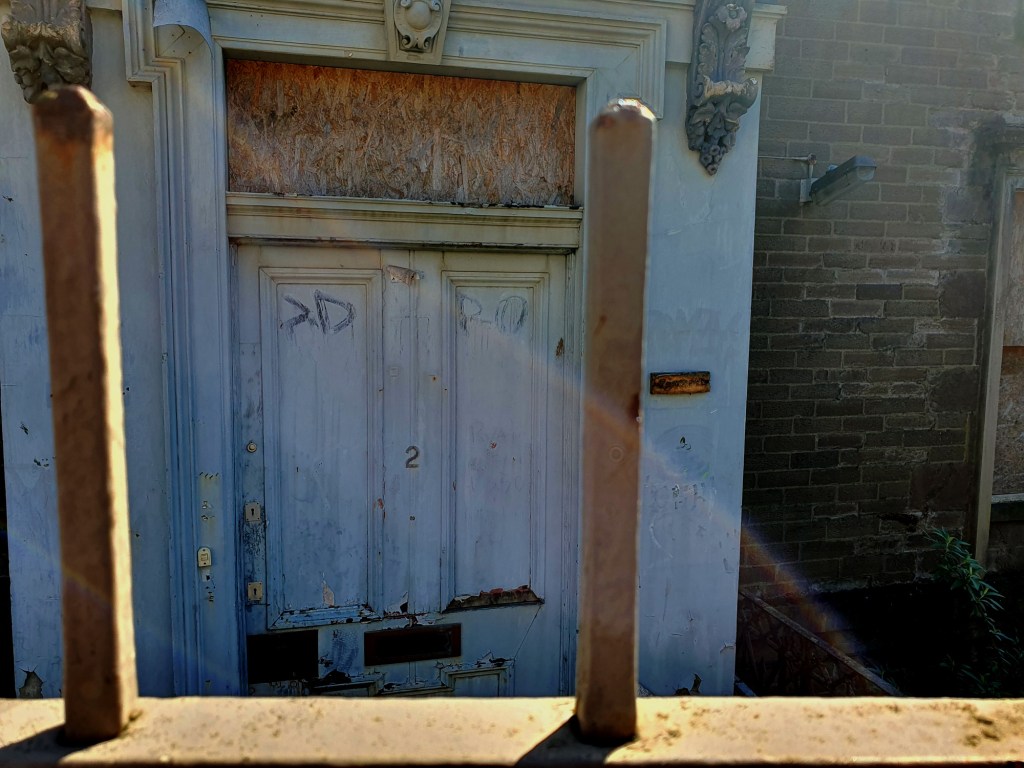
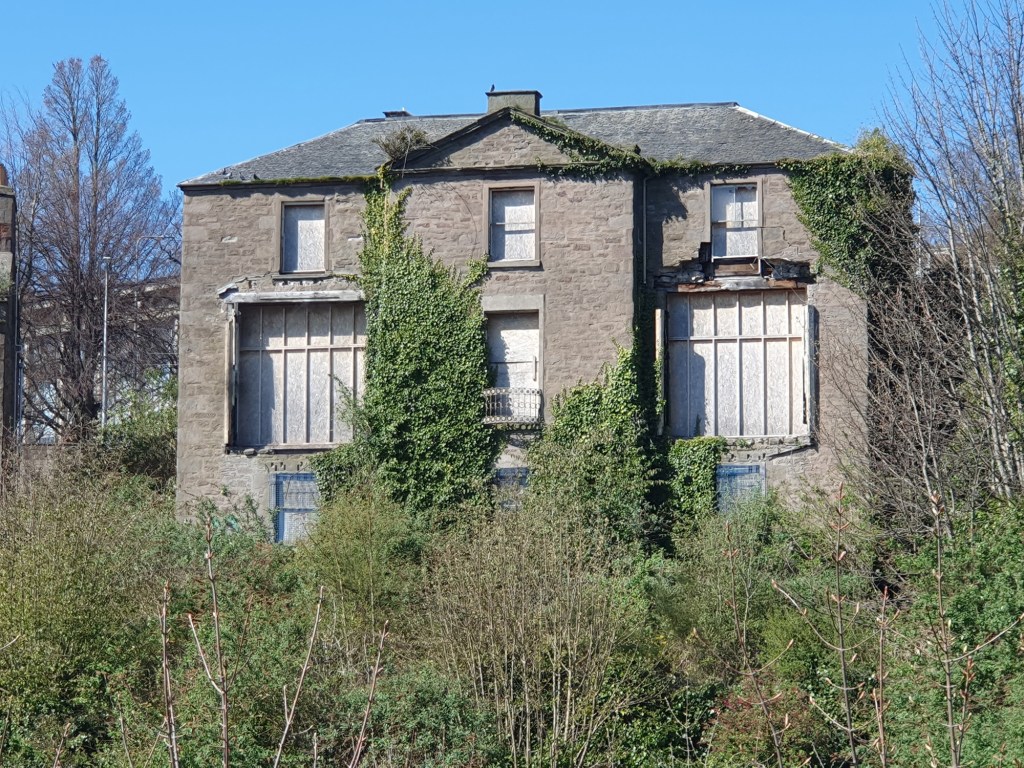
Frequently referred to as ‘Dundee’s Murder House’, 2, Roseangle is a Georgian villa with a grisly past and an uncertain future. Straddling the broad junction between Perth Road and Roseangle, in the west end of Dundee, it has lain empty and abandoned for years.
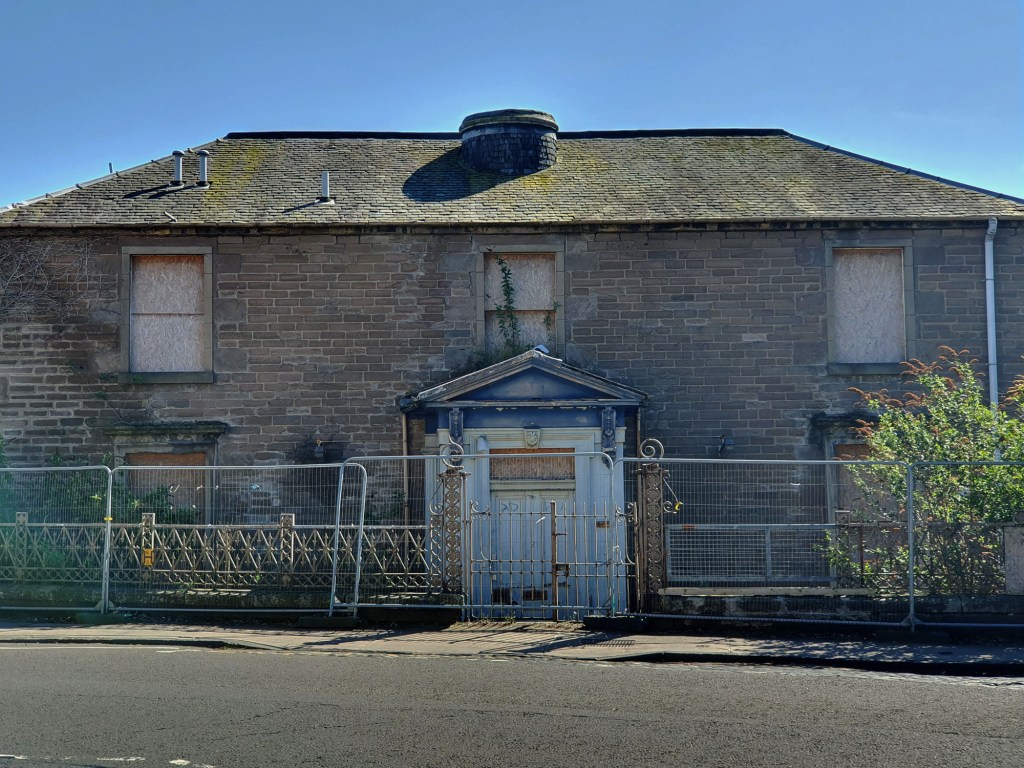
The two-storey property, with basement, was designed by town architect David Neave in 1815 for jute merchant David Martin, one of a row of grand villas stretching down Roseangle, then an affluent suburb of the city. In 1880, it was significantly altered with the addition of two large bay windows on the rear elevation, between which there was a small cast iron balcony, mosaic tiles in the hallway, and elaborate plaster ceiling decoration and cornices in the main rooms, entrance hall and stairwell. A small cupola was added on the roof, above the stairwell. Canmore has an extensive set of internal photographs.
For many years – until one evening in May 1980 – 2, Roseangle was home to Dr Alexander Wood, a retired GP, and his wife Dorothy. For many years, Dr Wood ran his surgery from the property but he was 79-years-old, frail and in poor health himself. He had retired in 1975 due to his ailing health and could only walk with the aid of sticks. Both he and his 78-year-old wife were brutally hacked and bludgeoned to death with a hammer after they disturbed 29-year-old Henry John Gallagher, who had broken into their house. Born in the city, Gallagher was a petty crook with a history of theft, burglary and assault.
After killing the couple, Gallagher calmly arranged their broken and battered bodies in chairs by the table in the basement kitchen, stole around £2000 worth of jewellery and silverware, and fled the scene, and the city. The couple were discovered several days later, on May 18, by a group of young students retrieving a ball accidentally kicked into the garden. Concerned they might get into trouble for venturing into the property, one of the students peered in through the kitchen window to check if anyone was about, and spotted the propped up bodies.
The police were called and their investigation led them to Gallagher, who was on weekend leave from Maidstone Prison, where he was serving a three year sentence for assault, at the time. But just days after the Dundee murders, he struck again, this time in Kent. Gallagher had taken refuge in St Ethelbert’s Church, in Ramsgate, Kent, where, on May 23, he beat 88-year-old Father Edward Hull and his housekeeper Ethel Maude Lelean to death within the presbytery. Moments earlier, Catholic Gallagher had entered the confessional where he admitted to the murders of Dr Wood and his wife. Father Hull had reacted with horror and called for his housekeeper, who survived the attack but died in hospital a few days later.
Gallagher ransacked the house before running off. He was apprehended seven days later in York after an extensive police manhunt. He was convicted of the manslaughter rather than the murder of Father Hull and his housekeeper, on the grounds of diminished responsibility, and was sent to Broadmoor Hospital, a high security psychiatric hospital in Berkshire, where he remains.
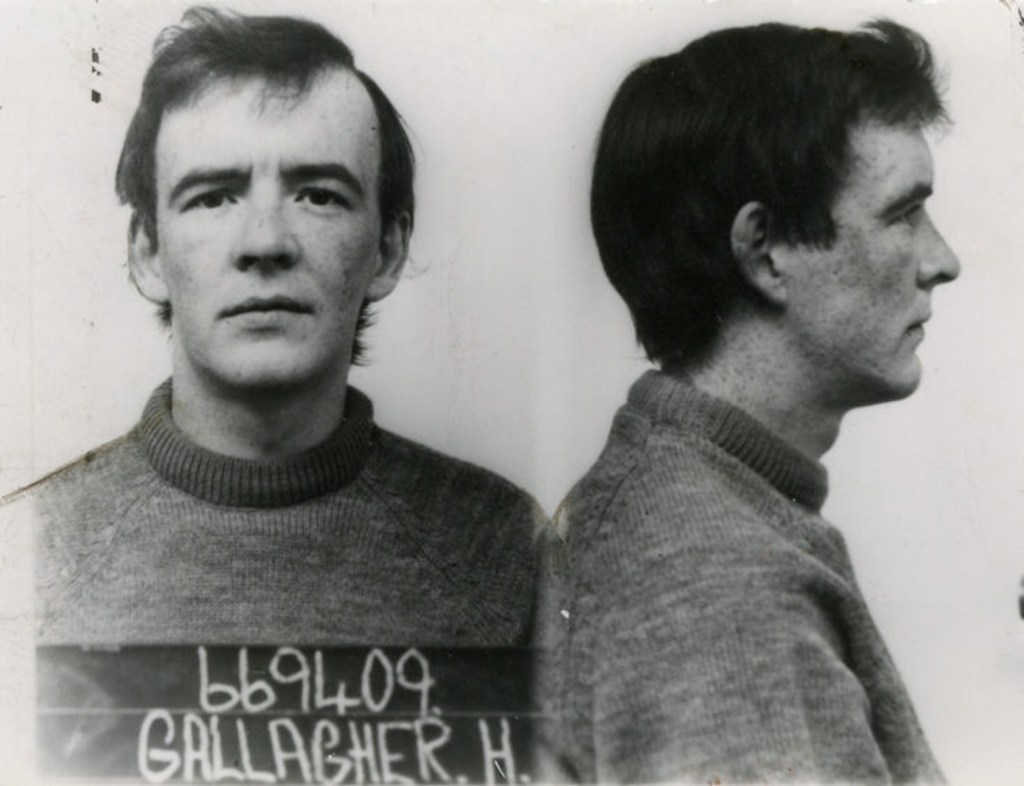
At the time, he told police he was responsible for the Roseangle deaths but the Lord Advocate ordered no further action be taken and he never stood trial in Scotland. The case remains technically unsolved and open.
Gallagher publicly confessed to the Dundee murders in 1993 in a 22-page account of his life and crimes penned in Broadmoor Hospital and published, under the name Henry John Read, by Granta as part of an anthology of gruesome real-life stories, entitled Blind Rage. He wrote that he broke into the house by a basement window and revealed he had been in the basement for just a few minutes when Mrs Wood opened the door and confronted him.
‘The old woman pointed her finger in my face – she was that close – and screeched for the police. I put my hand on her arm, trying to calm her down,’ he stated.
Dr Wood appeared and began hitting Gallagher with his cane. Fending the couple off, Gallagher claimed he ‘went crazy’ and began hitting Dr Wood and his wife with ‘anything and everything’ he could lay his hands on. Minutes later, they were lying on the floor, covered in blood. It later transpired that the murder weapon was a slater’s hammer.
After the murders, the house was bought by Dundee University as student accommodation. It was purchased in June 2007 by artist Nael Hanna for £400,000. He converted it back into a single dwelling and, the following year, planning permission was granted to change it into a restaurant. However, Mr Hanna’s bid to breathe new life into the property was thwarted by vandals and, in 2017, he admitted defeat and the house was back on the market, sold at auction, netting the owner less than half the original purchase price, £175,000.
Plans for a restaurant continued to be discussed but have yet to come to fruition and the property remains increasingly derelict, its extensive garden to the rear and the surrounding ground heavily overgrown. It remains on the Buildings at Risk Register and is a category B listed building.
If you have enjoyed this post, and others on the site, you might like to buy me a coffee which helps support the site and funds new content… Or visit my Kofi page.
You might also enjoy my new book, Abandoned Dundee, a fully illustrated guide to some of the more interesting and prominent abandoned and derelict buildings and sites in Dundee, available in paperback or as an ebook from Amazon.


2 Comments