
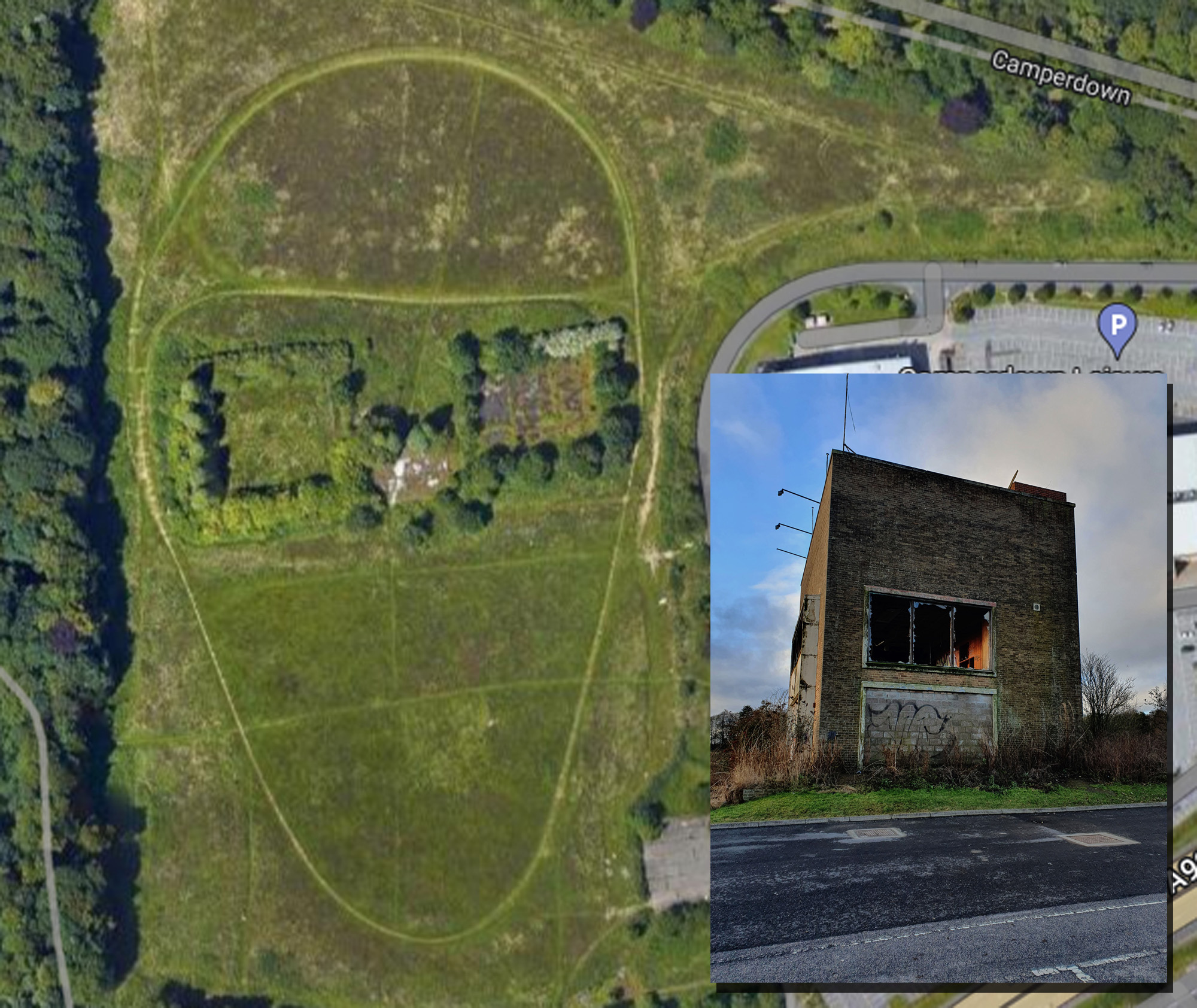
On the north-western periphery of Dundee, adjacent to Camperdown Country Park, satellite images reveal the likeness of a giant face – or perhaps alien head – embedded into the grassland. Spotting this, my curiosity aroused, I set out to explore this aerial anomaly – visible on both Google Maps and Bing Maps – and discovered remnants of the city’s industrial past; the efforts made to tempt America to invest in its first post-war factory in Scotland, and a development that would not only diversify the nation’s industrial base but also transform a machine we all now take for granted.
The strange face – complete with spectacles – occupies an area of open ground bounded to the west and north by the wooded fringes of the country park and, to the east, by an ice arena and leisure park. Primarily used by dog walkers, it is a broad swathe of grass, at the centre of which I found the ‘eyes’. They date from the 1940s and are among the scant remains of a once busy factory that, at its peak, boasted the city’s largest workforce.
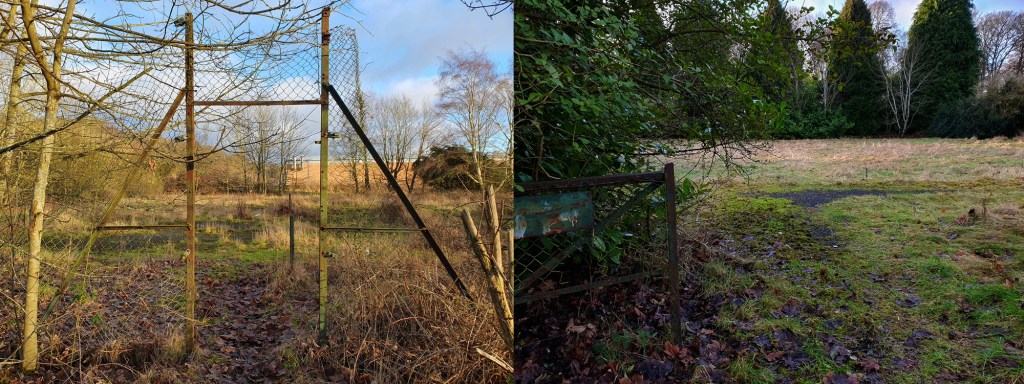
Remains of tennis courts (left) and bowling green (right)
After the Second World War, Dundee was keen to attract inward investment. The city sustained relatively little bomb damage, had a good infrastructure and a ready supply of skilled workers following the collapse of the traditional jute industry. Dundee Corporation earmarked land from its Camperdown Estate, zoning it for industrial use, and the plan paid off. Time Corporation was tempted to the city, establishing Timex UK in 1947 to manufacture watches, following hot on the heels of NCR.
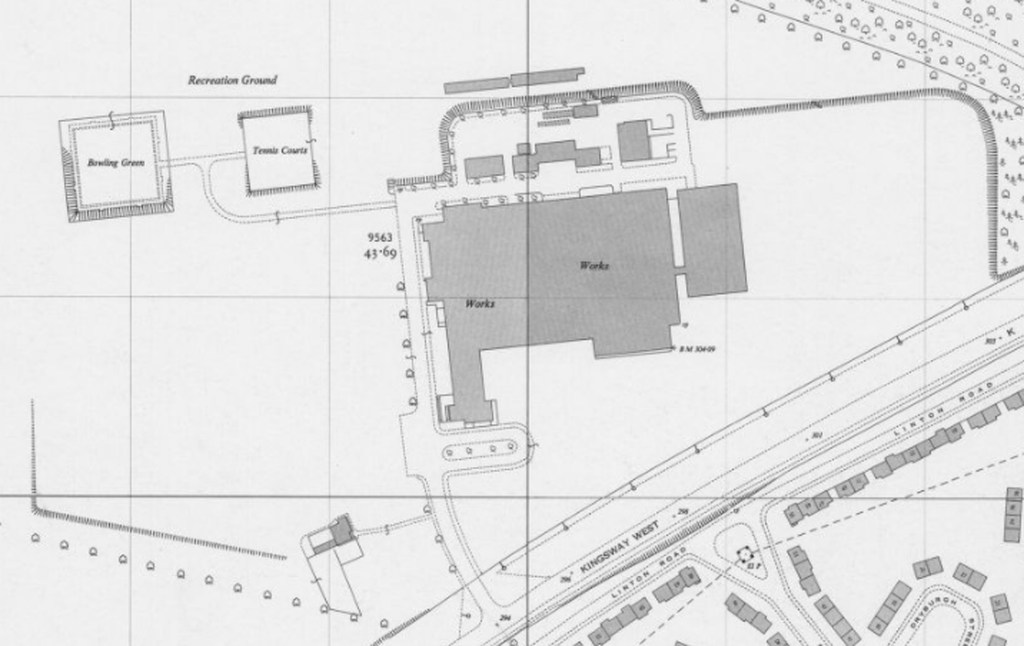
Ordnance Survey map of NCR Camperdown in 1960, showing bowling green and tennis courts (National Library of Scotland)
Both factories were designed by architects Bennet, Beard and Wilkins and built primarily of brick and concrete. The 110,000 square foot NCR Camperdown plant was officially opened on June 11, 1947, to make cash registers and accounting machines. The business thrived, growing rapidly during the 1960s. By 1970, the company was the city’s biggest employer with a workforce of 6500 people, a surge in demand its products prompted by decimalisation in 1971.
The company attracted workers with good pay and conditions and a range of perks including a welfare department, social activities, a canteen and sports and recreational facilities. There were badminton, golf, bowling and tennis clubs. And it is the remains of the latter that I found shrouded in trees and shrubbery to the west of the ice arena that now occupies part of the old factory site.
The open land was designated a ‘recreation ground’ for the workers. Aside from parkland and gardens, it boasted a pair of tennis courts and a bowling green. Evidence on the ground suggests there was a pavilion of sorts, a concrete base now all that remains of this.
Around the old tennis courts, sections of the wire fence and gates survive, merging into the bushes, along with metal poles that supported the nets and an asphalt surface which now lies beneath a thick layer of grass and moss. The neighbouring bowling green is equally overgrown but remains discernible. A well-established oval path traversing the grassland forms the perimeter of the mysterious ‘face’.
It’s rather sad to think that a pair of abandoned tennis courts and an overgrown bowling green are among the only surviving physical reminders of such an industrious and enterprising past, one integral to the success of the city, but there is another remnant of NCR Camperdown, a ghostly structure that haunts the site, its days doubtless numbered.
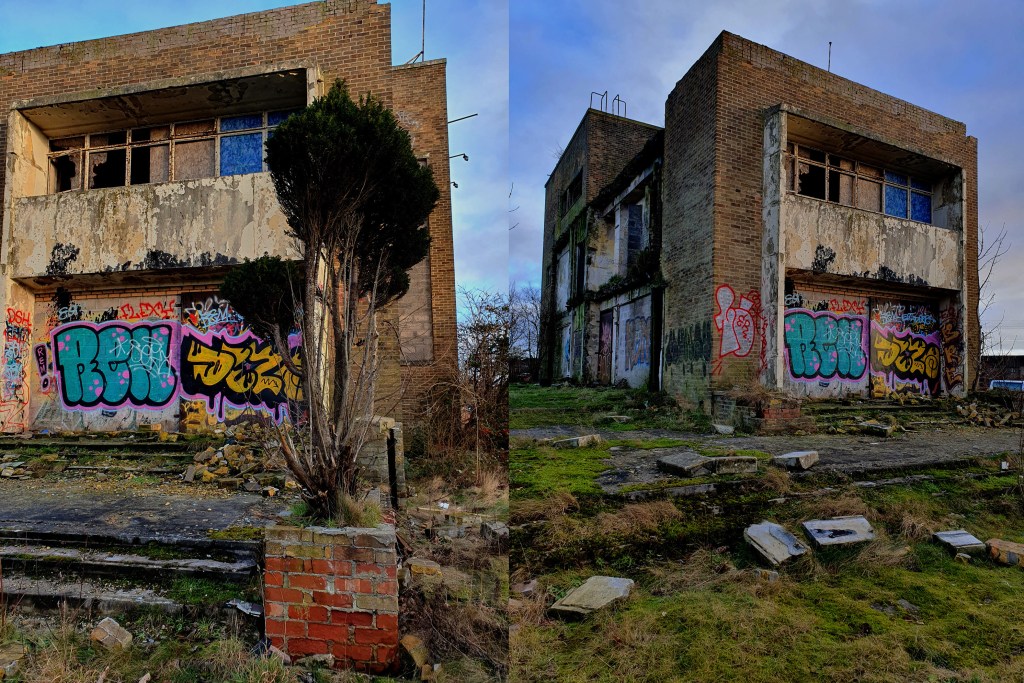
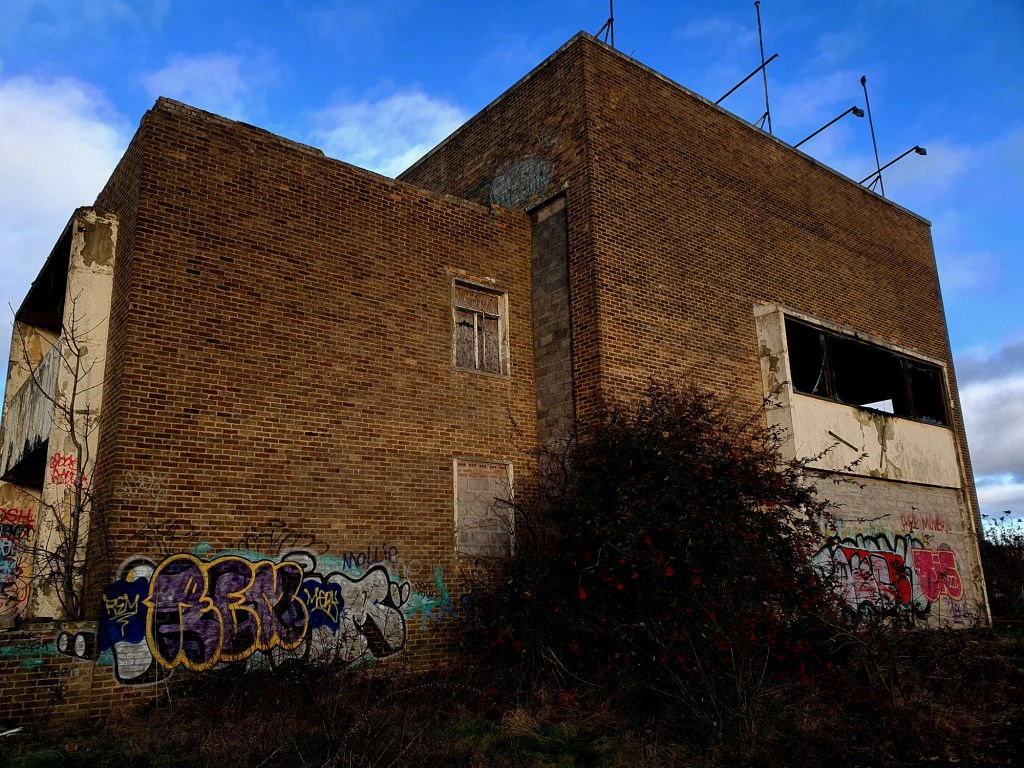
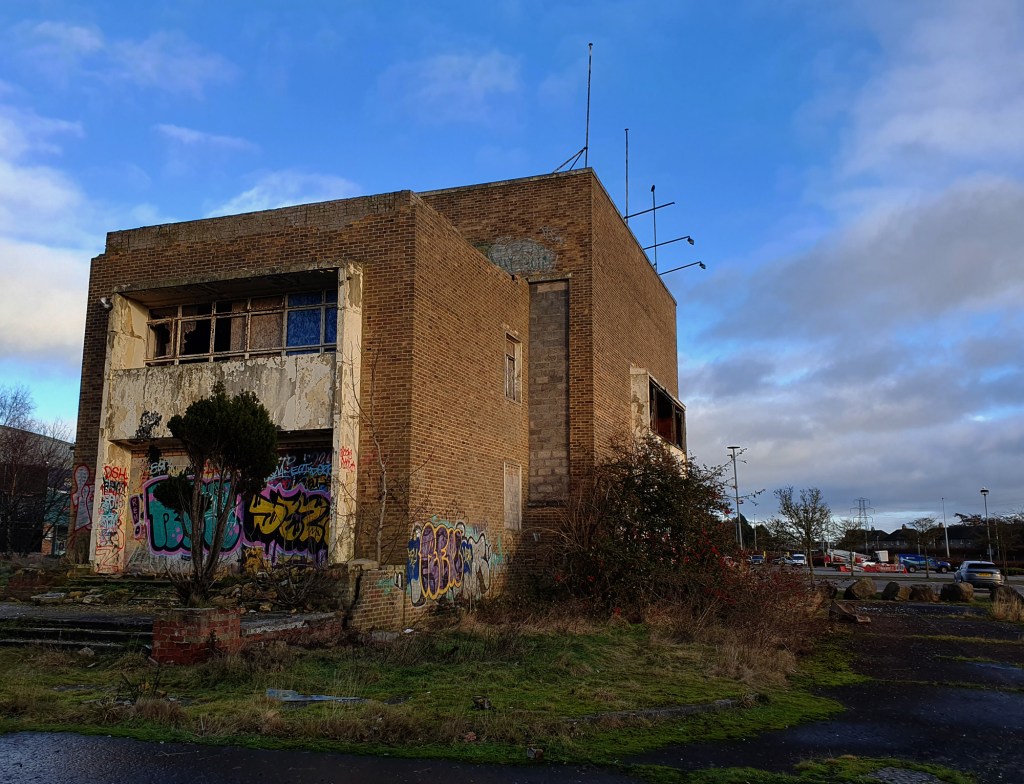
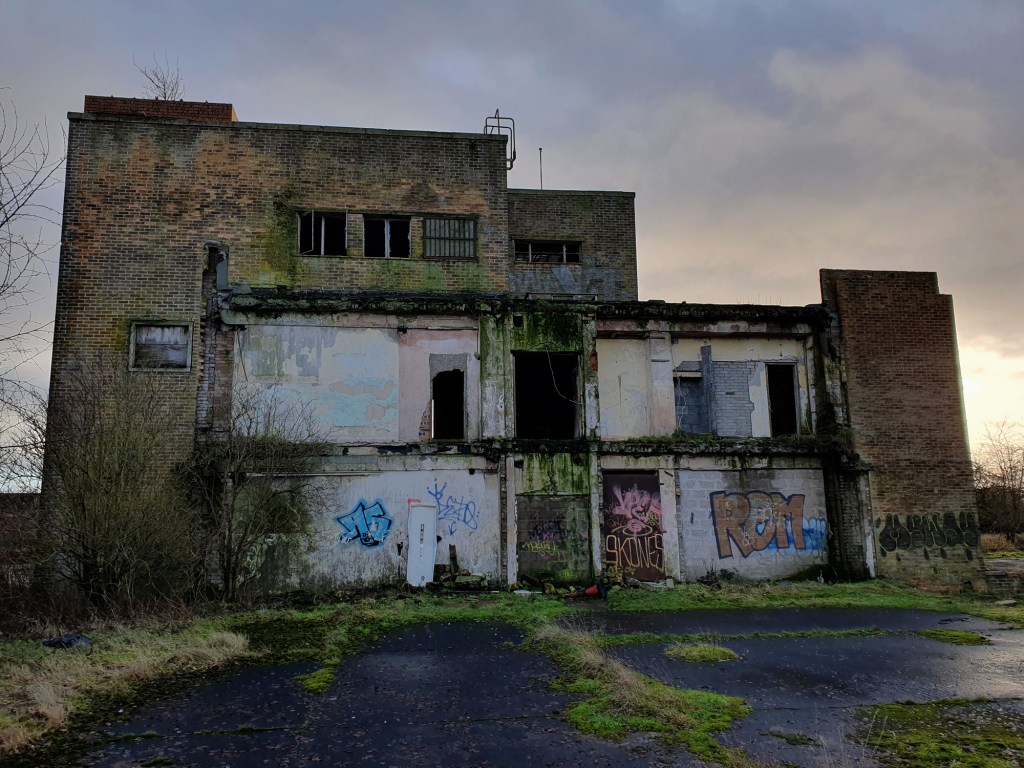
Decaying and standing very much at odds with its surroundings, a small corner of the factory escaped the bulldozers when the site was levelled in the late 1990s to make way for the leisure park. Internally elegantly panelled with dark wood and decorated with a mural, commemorative plaque, and crisp stainless-steel fixtures, the three-storey reception block housed the entrance foyer with offices above.
It stands adjacent to the recreation ground, to the south of the old tennis courts and bowling green, and, in its days, would have welcomed visitors to the plant, among them visiting executives from NCR’s American headquarters.
NCR – National Cash Register – was founded in Dayton, Ohio, in 1884 to manufacture the world’s first mechanical cash register, followed in 1906 by the first electrically-powered cash register. During the second world war it developed code-breaking machines and, after the war, moved into new computing and communications technology, introducing its first electronic device – a banking machine – in 1956.
The world’s first ATM opened for business at a branch of Barclays in Enfield, London, in June 1967 and the 1970s saw the widespread installation of NCR’s Model 770 at Barclays and NatWest banks throughout the UK. However, it was the launch of the NCR 5000 series, designed and built in Dundee, that would revolutionise the industry and see the company go on to dominate the cash point market.
Ironically, at the time, NCR Dundee was in decline. It faced an uncertain and rather bleak future, due to the fall in sales of cash registers prompted by increasing competition from Japan and the movement of production overseas where labour was cheaper. Redundancies prompted strikes and, by the end of the 1970s, the workforce was down to 1000. Its American owners were ready to pull out of the city.
Appointed head of NCR Dundee in 1979, Jim Adamson was given six months to turn around the fortunes of the company in the city. While NCR was busy developing ATM technology in Ohio, he knew Dundee could do better and, setting up an engineering division with little in the way of funds, he and his workers unveiled the NCR 5070 in 1984. Three years later, as NCR Dundee became a fully electronics-orientate facility, 50,000 of these machines had been made in the city and it soon became the most successful product in NCR’s global history, spawning several new generations as technology progressed and new innovations were made.
Sadly, it came too late for NCR Camperdown which was closed in 1980. However, its sister factory built in the 1960s at Wester Gourdie, a mile or so away, continued developing and manufacturing ATMs until its closure in May 2009 when production switched to Hungary. While ATMs are no longer made in Dundee, NCR retains a presence in the city with its Research and Development Centre.
In 1986, the vacant Camperdown factory was taken over by Dutch textiles firm Van Leer for the manufacture of polypropylene bulk bags, which continued until 1995 when it shut its doors for the final time. The land reverted to the city council which was keen to build a new ice rink.
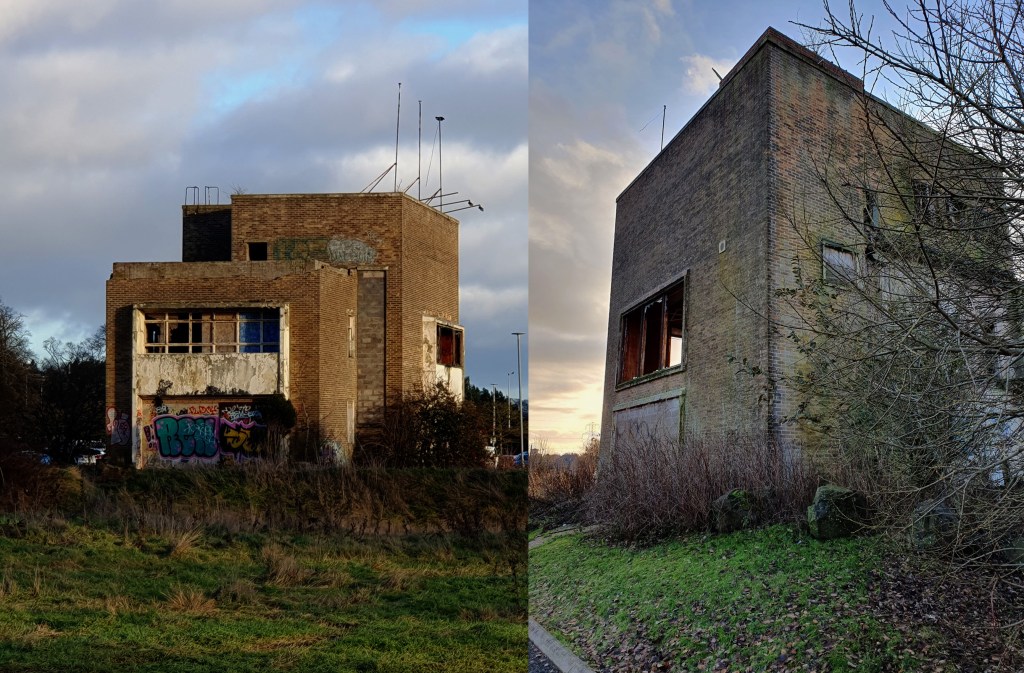
Despite its category B listed status, most of the factory had been demolished by 1999, leaving only the reception block on its south-west corner which stands to this day, isolated and abandoned. The original intention was to transform this into a heritage centre, but the plans never came to fruition, although an ice arena, cinema, hotel, restaurants and two fast food outlets were built on the rest of the factory site. Later proposals to convert it into a garden centre also floundered.
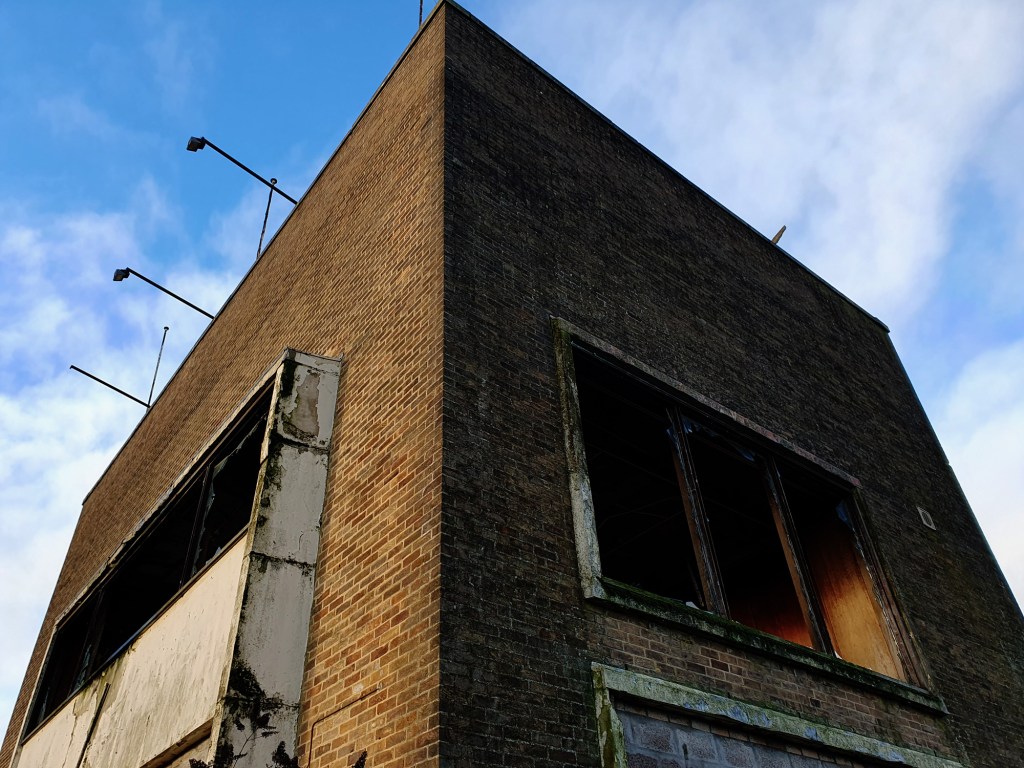
While new buildings sprang up alongside it, the neglected three-storey reception block was allowed to slowly decay and, despite efforts to board it up and fence it off, it was regularly targeted by vandals and has found a place on the Buildings at Risk Register. Now, with all ground floor access points bricked up, its primary role is as a roost for pigeons which fly in and out of the shattered upper floor windows and open doorways.
Listed building consent was granted for its demolition in 2009, allowing developers to expand the leisure park. However, economic downturn has thus far given it a stay of execution. For how much longer this heavily graffitied yet very visible memorial to the city’s prosperous industrial past can hold out, remains to be seen.
If you have enjoyed this post, and others on the site, you might like to buy me a coffee which helps support the site and funds new content… Or visit my Kofi page.
You might also enjoy my new book, Abandoned Dundee, a fully illustrated guide to some of the more interesting and prominent abandoned and derelict buildings and sites in Dundee, available in paperback or as an ebook from Amazon.


