
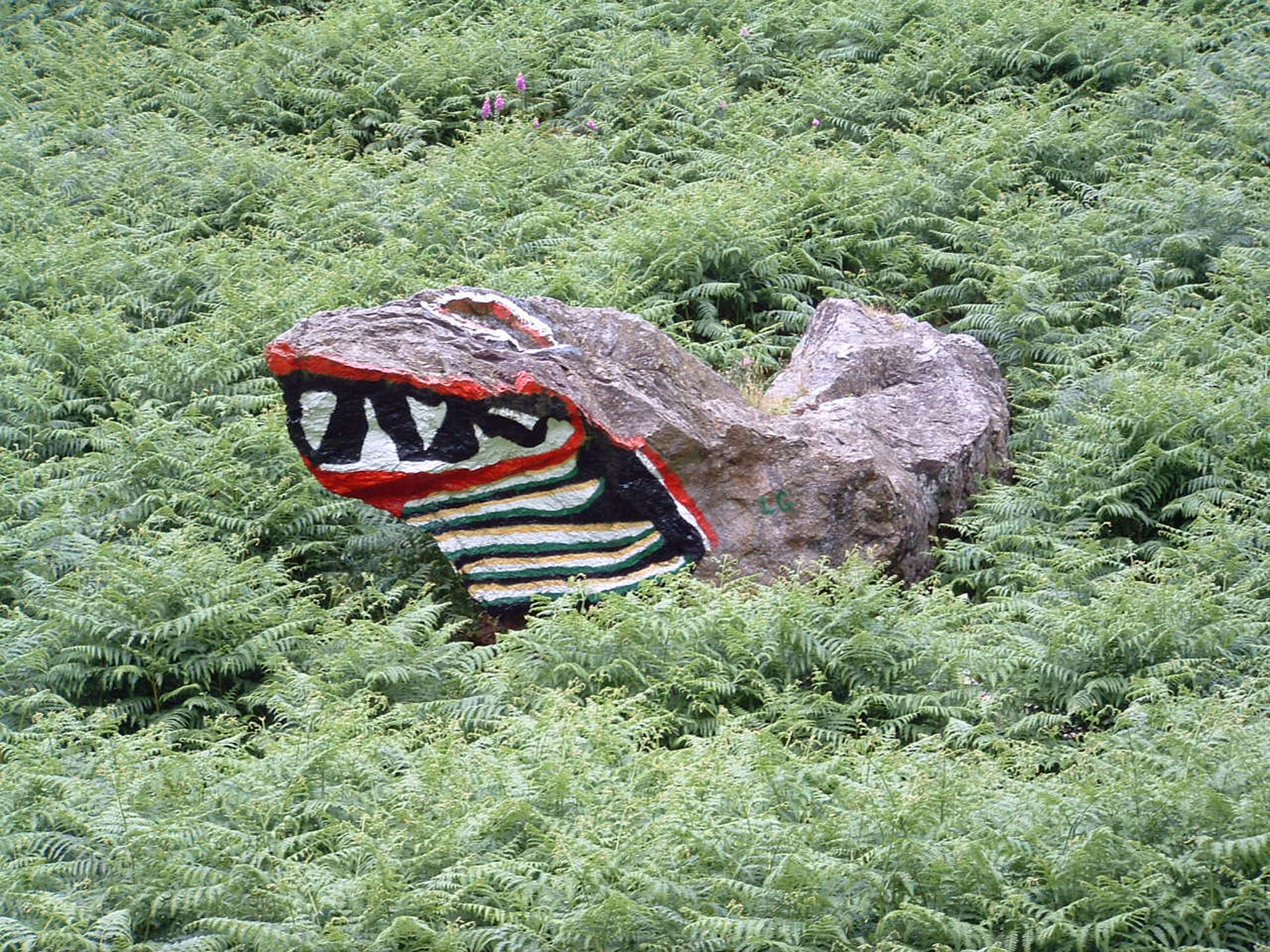
As a child St Fillans Serpent was one of the highlights of car journeys across Scotland. Living on the east coast, we regularly made the trip west on the A85, en route to family holidays at Loch Goil.
As we approached the hamlet of St Fillans, at the eastern end of Loch Earn, our eyes were always peeled for the well-known local landmark. Roughly carved by man at some point in time in the distant past, the serpent is a lone rock sitting just back from the road on the lower slopes of Little Port Hill.
The stone is steeped in ancient folklore but what captured our imagination was the way it was painted to resemble a mythical beast. We knew nothing of its cultural importance. All we saw was a scary monster with huge, razor-sharp teeth and a blood encrusted jaw rising up from the undergrowth, ready to pounce as we motored past. We always evaded its grasp, but the prospect of attack never failed to instill apprehension and awe within curious young minds.
The St Fillans Serpent is a unique part of the Perthshire landscape. No one knows exactly when it was carved but it was probably thousands of years ago. What is known is that it lies upon a straight ley line crossing the Earn Valley.
Our ancient ancestors bestowed huge significance in these ley lines, believing they focused natural earth energies through their dead. Burial grounds were located on the lines and a network exists within this part of Highland Perthshire. A little over a mile from the serpent lies the remains of an ancient burial chamber. The lines themselves were marked with carves stones, like the serpent.
While such carved stones are not uncommon, the serpent is unusual in that for as long as people living in this area can remember it has been painted. Locals have ensured the tradition continues to this day.
Some say it resembles a crocodile and it is frequently referred to as the St Fillans Crocodile. This is, however, something of a contradiction. While snakes, serpents and dragons all feature strongly in traditional local folk tales, crocodiles do not.
The look of a crocodile is not immediately apparent either. Indeed, the stone does not really look like any known creature and the colour scheme – red eyes, sharp white teeth, red lips and a black, green and yellow chest – is far removed from any of Mother Nature’s creations.
The serpent sits around 100 metres back from the road, beyond the long disused trackbed of an old railway line that, up until the 1960s, ran between Crieff and Lochearnhead. It occupies a gap in the trees on the lower slopes of Little Port Hill and, during the summer months is flanked by thick bracken. The lack of parking nearby means few people venture up to the stone; most are content to simply catch a glimpse as the drive past.
If you do want a closer look, the easiest way to reach it is to leave the A85 at a gate a short distance east of the stone. It is possible to get a car off the road here, on to the verge. A track passes through sheep enclosures and over grazing land to join the line of the old railway. Go left and walk around 400 metres west. Look out too for a stone painted to resemble a frog which sits by the side of the road.
If you have enjoyed this post, and others on the site, you might like to buy me a coffee which helps support the site and funds new content… Or visit my Kofi page.


