
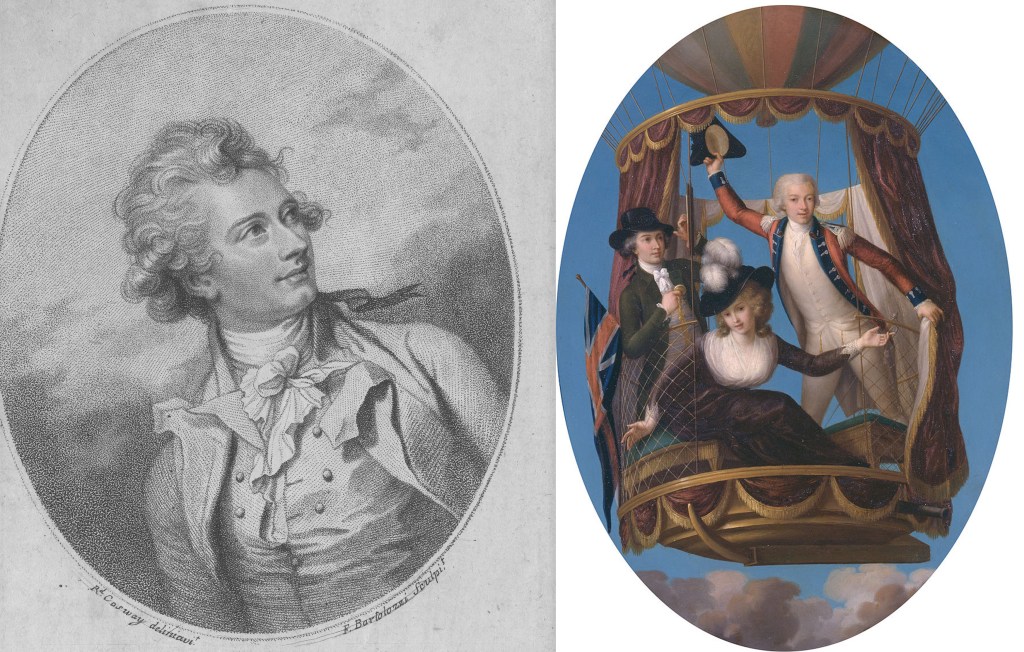
When aeronautical pioneer Vincenzo Lunardi took off amid much fanfare from Edinburgh in his hot air balloon on what was to become Scotland’s first notable flight he probably had little idea where he would end up.
At 3.45pm on the afternoon of October 5, 1785, a large crowd gathered in the grounds of George Heriot’s School in the capital to witness the brightly coloured hydrogen-filled balloon take to the sky. The Scots Magazine noted: ‘The beauty and grandeur of the spectacle could only be exceeded by the cool, intrepid manner in which the adventurer conducted himself.’
Lunardi was not the first to attempt balloon flight in Scotland, but he did fly much further than previous pioneer James Tytler who conducted his test flights in Edinburgh a year earlier but only managed to gain an altitude of 350 feet and travelled a distance of just half a mile. The Angus-born chemist and former Church of Scotland minister is, however, credited with being the first person in Britain to fly by ascending in a hot air balloon, but his achievement was without the showmanship of Lunardi and was completely outshined.
Driven by the prevailing wind, the adventurous Italian, whose flights were always something of a spectacle, soared to a height of over 2000 feet, drifting out across the Forth Estuary before making landfall once again at Lower Largo, on the Fife coast. On the way over the river, he waved to the astonished crews of boats below him.
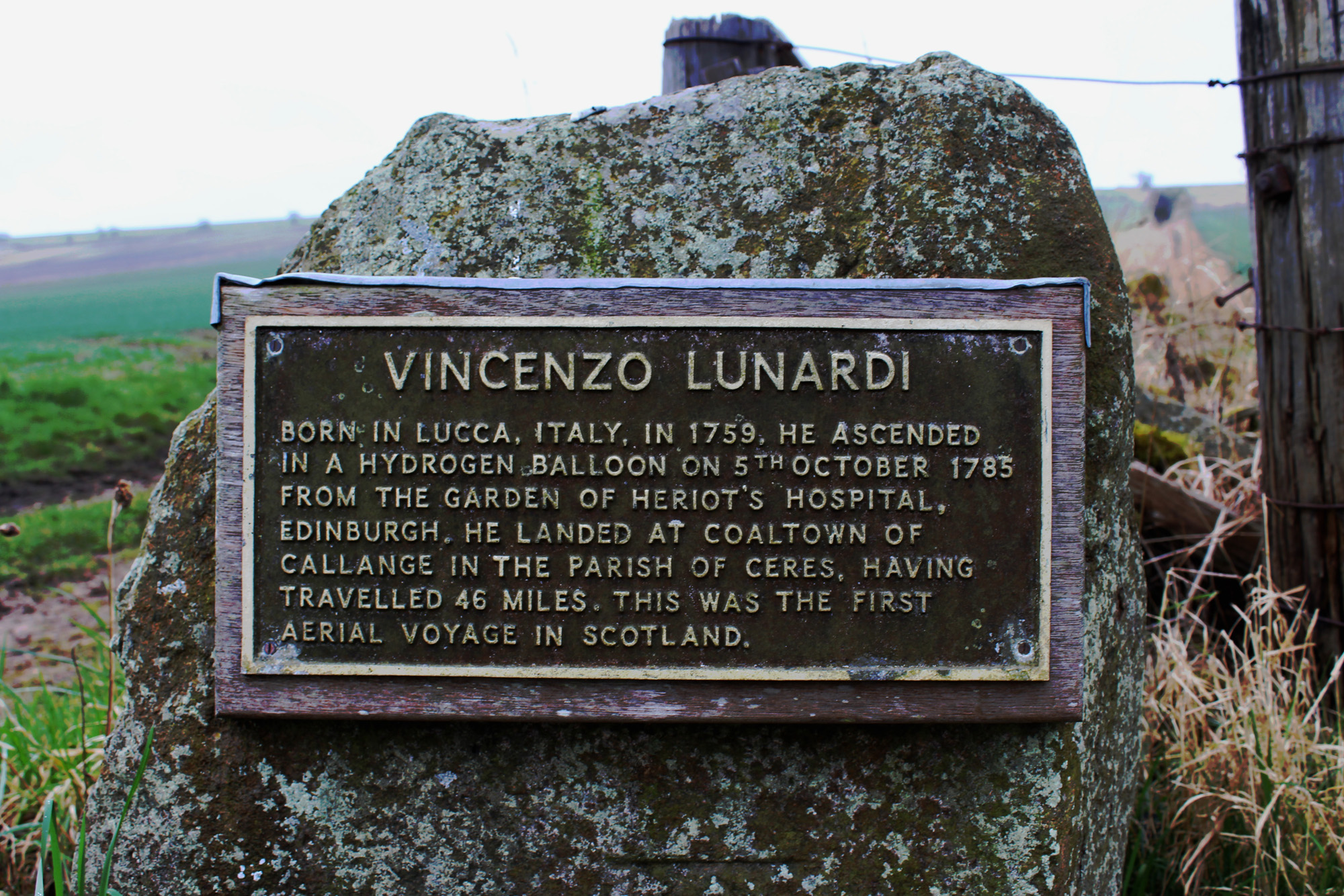
Lowering the balloon to 1000 feet, he flew north across the kingdom and, after a 46-mile journey blessed by clear skies, finally touched down in a field at Coaltown of Callange, to the east of the historic village of Ceres. A roadside plaque mounted on a stone slab – a small tribute to commemorate a lofty achievement – marks the unremarkable spot where the epic flight ended.
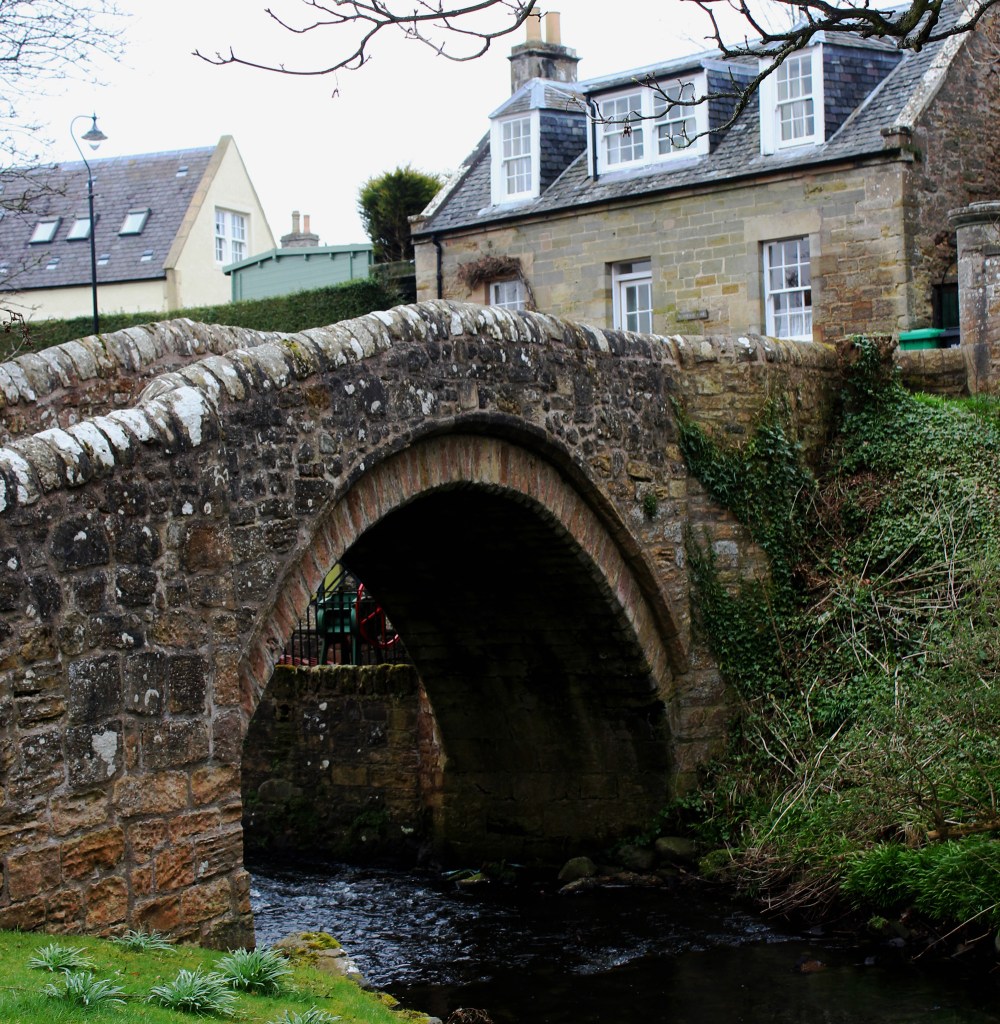
It is a little over a mile’s walk from Ceres, setting off from the 17th century Bishop’s Bridge, in the heart of the village. Approaching on foot, follow Castlegate to Craighall Terrace, cross, bearing left, and continue along Schoolhill. At its end, go right through a wooden gate and hike along a footpath (signed Callange). The path follows the Fife Pilgrim Way east to meet the B940 at Callange. The way follows an 11th century pilgrims’ route linking the abbeys of Culross and Dunfermline with St Andrews Cathedral. The plaque stands by the side of the road, at the corner of a field.
Branded the ‘Daredevil Aeronaut’, Lunardi rested in Cupar, a few miles from Ceres, for several days before being taken to St Andrews where he was met by local dignitaries and granted the freedom of the town. A ball was held in his honour and he was admitted to various golfing clubs and high society organisations. In more recent years his connection with Cupar was marked with the naming of a street in the burgh – Lunardi Place – and a care home – Lunardi Court.
It was not long before he was in the air again and, in all, Lunardi clocked up five flights over Scotland. On October 16, 1785, he took off from Kelso and made the first successful cross-border hydrogen balloon flight, passing from Scotland into England. In November he flew 110 miles from Glasgow to Hawick, in the Scottish Borders, and, in December, he took off once again from Glasgow but, after a troubled launch, came down in the Campsie Fells, to the north of the city, after covering just 10 miles.
Scots paid a shilling a head to view his yellow, green and pink silk balloon when it was put on display suspended within Glasgow Cathedral and a brief trend among fashionable ladies for balloon-shaped hats spawned the ‘Lunardi Bonnet’.
His final Scottish flight, which took off from Edinburgh on December 20, 1785, was a bit of a disaster, ending abruptly when he was forced to ditch in the chilly waters of the Forth Estuary, landing close to the Isle of May. Lunardi managed to stay afloat in his basket long enough to be rescued by the crew of a passing fishing boat.
The experience, however, did not deter him and, both before and after his time in Scotland, he made a series of pioneering flights in England, eventually leaving Britain for good after one of his assistants died in a launch accident in Newcastle. Thereafter he toured Europe with his magnificent fly machine.
Lunardi recorded his Scottish aerial escapades in a book entitled An account of five aerial voyages in Scotland, a copy of which now resides with the Special Collections unit at the University of St Andrews.
After a lifetime of adventure, he died in Portugal in 1806.
If you have enjoyed this post, and others on the site, you might like to buy me a coffee which helps support the site…

 Secret Scotland